 Fazlur Rahman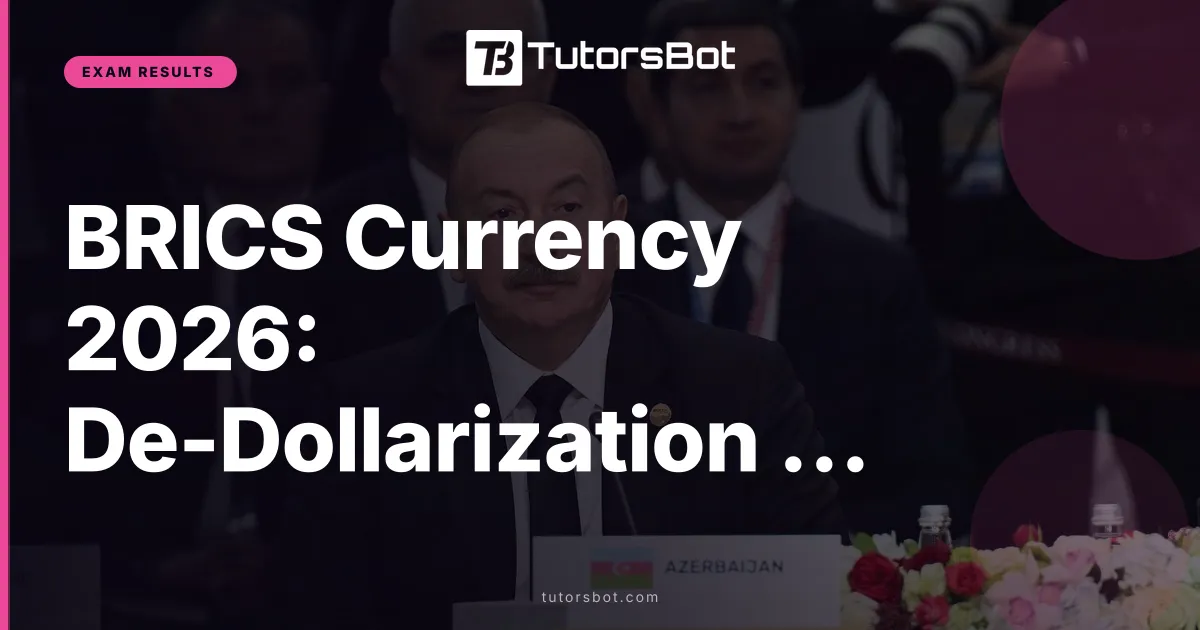
Published September 13, 2026 - New Delhi / Washington.
Currency and de-dollarization language from BRICS finance ministers, central bank governors, and the New Delhi Declaration; tariff threats from the White House; data on dollar reserve share last verified by Atlantic Council and IMF COFER in September 2026.
BRICS has not launched a common currency. At the New Delhi summit on September 12-13, 2026, finance ministers and central bank governors objected to unilateral US tariffs as inconsistent with WTO rules, while the leader-level New Delhi Declaration pushed for non-dollar cross-border payment channels, broader use of local-currency settlement, and a stronger role for Special Drawing Rights (SDR). The dollar's actual share of global reserves has fallen only modestly since 2015, and the headline announcements should be read as a multi-year diversification strategy rather than a single replacement event.
What BRICS actually said on currency
The 140-paragraph New Delhi Declaration contains some of the bloc's strongest language yet on the international monetary system. The declaration welcomes the expansion of BRICS Cross-Border Payments Initiative members, encourages the New Development Bank (NDB) and the Contingent Reserve Arrangement (CRA) to expand local-currency operations, and notes that strengthening the international monetary system requires a more representative and balanced network of reserve currencies. It does not, however, propose a common BRICS currency, a BRICS central bank, or an outright exit from the US dollar (Reuters via Al-Monitor, Mint, September 2026).
Technical work continues on three existing payment rails. China's Cross-Border Interbank Payment System (CIPS) processed more than 12 trillion yuan in cross-border transactions in 2024, Russia's SPFS now serves more than 500 Russian and foreign institutions, and the BIS Innovation Hub's mBridge project has run live pilots settling cross-border payments in central bank digital currencies among the central banks of China, the UAE, Thailand, and Hong Kong. BRICS members have agreed to coordinate regulatory standards and anti-money-laundering compliance so these systems can be used together more reliably (South China Morning Post, Reuters, September 2026).
What the finance ministers said before the summit
In the days before the leader-level meeting, BRICS finance ministers and central bank governors issued a joint statement objecting to unilateral US tariffs as inconsistent with WTO rules. The statement, which followed a virtual meeting of the group, also called for the IMF and the World Bank to remain relevant through better representation of emerging economies, and asked the G20 to play a more active role in coordinating debt treatment for low-income countries. The statement avoided naming the United States but the framing was widely read in financial markets as a direct response to tariffs imposed by Washington in 2025 and 2026 (Mint, Xinhua, September 2026).
Trump's tariff threat and the bloc's response
President Donald Trump has repeatedly called BRICS anti-American and threatened an additional 10 percent tariff on any country that aligns itself with what he described as anti-American policies of the bloc. The threat was reiterated in the run-up to the New Delhi summit. BRICS governments have not publicly responded to the threat in dollar terms; instead, the New Delhi Declaration refers to the importance of a rules-based, open, fair, and non-discriminatory multilateral trading system, language that is widely interpreted as a response to the US tariff regime without naming Washington (Reuters, Xinhua, September 2026).
How much de-dollarization has actually happened
Data from the IMF's COFER database and the Atlantic Council's Global Dollarization Monitor suggest the dollar's share of global foreign-exchange reserves has fallen from roughly 66 percent in 2015 to about 58 percent in 2026, while the share of the renminbi, the euro, the yen, gold, and a long tail of smaller currencies has risen modestly. The dollar still dominates cross-border transactions, commodity pricing, and the offshore funding market, so the shift is best read as gradual diversification rather than a sudden break. Reserve managers are also constrained by the depth and liquidity of US Treasury markets, which remain the single largest pool of safe assets in the world (Atlantic Council, IMF, September 2026).
Mechanisms being built in 2026
| Mechanism | What it does | Status |
|---|---|---|
| CIPS (China) | Cross-border yuan clearing, paired with SWIFT messages or with CIPS's own messaging layer | Live, growing rapidly |
| SPFS (Russia) | Domestic payments alternative after the 2022 SWIFT sanctions; limited international reach | Live, primarily for sanctioned parties |
| mBridge (BIS Innovation Hub) | Wholesale CBDC settlement across multiple central banks | Pilot phase, transitioning to minimum viable product |
| BRICS Cross-Border Payments Initiative | Coordination of regulatory standards, AML, and use of distributed-ledger technology | Mandated by 2026 declaration |
| Local-currency trade settlement | Bilateral invoicing in partner-country currency (e.g. rupee-dirham, rupee-ruble, rupee-rupiah) | Live for select corridors |
Why this matters for India
India is the world's largest recipient of remittances, with inflows of more than 130 billion dollars in 2024-25, and runs goods-trade deficits with several BRICS partners including China and Russia. Indian officials have supported local-currency settlement with the UAE, Indonesia, and the Eurasian Economic Union, while keeping the rupee fully convertible on capital account firmly off the agenda to avoid destabilising capital flows. The New Delhi Declaration gave New Delhi diplomatic cover to deepen those arrangements without triggering a US tariff response, although the Trump administration's threat of additional duties on aligners remains an open risk (Mint, The Indian Express, September 2026).
What to watch next
Three signals will indicate whether the de-dollarization agenda has real momentum. First, the share of BRICS intra-bloc trade settled in non-dollar currencies, which most estimates still place in the low single digits despite years of rhetoric. Second, progress on the BRICS Cross-Border Payments Initiative's working group, which is expected to report before China's BRICS chairship in 2027. Third, any new bilateral swap lines between BRICS central banks, which would deepen offshore liquidity for local-currency settlement. Until then, the dollar's role is changing at the margin, not at the centre (Reuters, Atlantic Council, September 2026).
FAQ
Did BRICS agree on a common currency in 2026?
No. The New Delhi Declaration of September 13, 2026 does not announce a BRICS common currency. Member states agreed to expand non-Western cross-border payment channels, study settlement in local currencies, and continue technical work on platforms such as mBridge, but a single shared currency remains off the table. The strongest language committed BRICS to strengthening the international monetary system and the role of the Special Drawing Rights (SDR) basket (Reuters via Al-Monitor, Mint, September 2026).
What did BRICS say about de-dollarization in 2026?
BRICS finance ministers and central bank governors met in the run-up to the New Delhi summit and objected to US tariffs as inconsistent with WTO rules, while calling for broader use of local-currency settlement and the development of alternative payment infrastructure. The New Delhi Declaration encouraged the New Development Bank (NDB) and the Contingent Reserve Arrangement (CRA) to expand local-currency operations, but did not endorse an outright exit from the dollar (Mint, Xinhua, September 2026).
What is the BRICS payment system proposed in 2026?
Discussions in New Delhi centered on expanding platforms such as China's Cross-Border Interbank Payment System (CIPS) and Russia's SPFS, alongside the BIS Innovation Hub's mBridge project, to settle cross-border trade in member-country currencies. Leaders also endorsed a BRICS Cross-Border Payments Initiative that will coordinate regulatory technical standards, anti-money-laundering compliance, and the use of distributed-ledger technology for clearing. The platform is operational in pilot form but is not yet a single unified BRICS alternative to SWIFT (Reuters, South China Morning Post, September 2026).
What did Trump say about BRICS in 2026?
US President Donald Trump has repeatedly called BRICS anti-American and threatened an additional 10 percent tariff on any country that aligns itself with what he described as anti-American policies of the bloc. The threat was reiterated in the run-up to the New Delhi summit. In practice, BRICS governments have avoided naming the United States in the final declaration, instead referring to the importance of a rules-based, open, fair, and non-discriminatory multilateral trading system (Reuters, Xinhua, September 2026).
Why is BRICS de-dollarization important for India?
India is the world's largest recipient of remittances and runs a goods trade deficit with several BRICS partners, so a partial shift away from dollar settlement could lower hedging costs and reduce exposure to US secondary sanctions. Indian officials have supported local-currency settlement with the UAE, Indonesia, and the Eurasian Economic Union, while keeping the rupee fully convertible on capital account firmly off the agenda to avoid capital flight (Mint, The Indian Express, September 2026).
Can the dollar be replaced as the global reserve currency?
Most economists and central bankers consider an immediate dollar replacement unlikely. The dollar still accounts for roughly 58 percent of global foreign-exchange reserves and is used in the majority of cross-border transactions, while no other currency has comparable depth, rule of law, and freely convertible capital markets. BRICS-led de-dollarization is best understood as a gradual diversification strategy, building parallel payment rails and expanding local-currency trade settlement, rather than a single replacement event (Atlantic Council, Reuters, September 2026).
Photo: Press Service of the President of the Republic of Azerbaijan, CC BY, via Wikimedia Commons (https://upload.wikimedia.org/wikipedia/commons/8/86/2024_BRICS_Summit_%281729759570%29.jpg?utm_source=commons.wikimedia.org&utm_campaign=imageinfo&utm_content=original)