Fazlur Rahman
Many teams compare these three tools on price alone. The harness vs github actions vs jenkins decision has no single number to weigh. Harness sells shared units. GitHub Actions bills build time against a monthly dollar credit.
Jenkins charges no licence fee because you run it yourself. Which platform fits depends on your headcount, your build minutes and how much patching you own. Below are the three published rate cards and the limits that create overage bills. An annual cost for three team sizes comes last. For how these tools line up against GitLab, read our GitLab vs GitHub guide.
Harness vs GitHub Actions vs Jenkins - what does each one charge in 2026?
In a harness vs github actions vs jenkins comparison, all three charge for the same work in different units. Harness meters everything into Subscription Units, so builds, deployments and storage share one pool. GitHub Actions meters compute in minutes and dollars. Jenkins meters nothing.
CI/CD, short for continuous integration and continuous delivery, means building and releasing software automatically. The GitHub pricing page lists Team at $4 per user per month. Team includes 3,000 CI/CD minutes a month and 2 GB of package storage. Enterprise Cloud is $21 per user per month. It includes 50,000 minutes, 50 GB of storage and a $300 monthly credit.
The Harness pricing page shows Free at $0 per month for up to 25 users. Free includes 1,000 Subscription Units a month and community support. Enterprise is not published. Harness prices it through sales, with unlimited users, custom units and volume discounts. One separate Harness page lists $480 per developer per year for CI licensing. It adds $0.01 per minute for 8-core Linux compute.
The Jenkins documentation publishes no price and no vendor fee. Jenkins is an open source automation server you install yourself. You can use system packages, Docker or a standalone install on a machine running Java. A Java Runtime Environment, or JRE, is that Java installation.
How do the three billing models differ, and what does a build minute cost?
The models differ. GitHub Actions meters minutes against a dollar credit, while Harness meters Subscription Units and cloud credits. Jenkins meters nothing. GitHub Actions runs from $0.002 on 1-core Linux to $0.062 on macOS. Harness Cloud runs from $0.005 to $0.180.
GitHub sets that credit at $12 a month on Free, $18 on Pro and Team, and $300 on Enterprise Cloud. The GitHub Actions billing documentation says the $300 covers about 50,000 minutes of a standard Linux runner. That rate is $0.006 per minute. Copilot code review draws on the same credit.
Harness units are shared, so every feature draws on one pool. One unit covers a Deployment Event. 60 units cover a Repo Built each month, up to 250,000 lines of code. 2 units cover each gigabyte of artifact storage each month.
Free plans also get 2,000 cloud credits a month, and unused credits expire at month end. Paid credits roll over but generally expire a year after purchase.
| Operating system and core class | GitHub Actions runner, USD per minute | Harness Cloud, USD per minute |
|---|---|---|
| Linux, 1-core | $0.002, x64 | Not offered |
| Linux, 2-core | $0.006, x64 | $0.005, xsmall |
| Linux, 4-core | Not in the baseline rate table | $0.010, small |
| Linux, 8-core | Not in the baseline rate table | $0.020, medium |
| Windows | $0.010, 2-core x64 | $0.020, 4-core small |
| macOS | $0.062, 3-core or 4-core M1 or Intel | $0.180, 6-core ARM64 Apple M4 |
Checked November 2026 on GitHub Actions billing documentation and the Harness CI subscription rate card, effective September 1, 2026.
Compare rows by core count, not by name. The 2-core Linux rows match: GitHub charges $0.006 and Harness charges $0.005. GitHub does not list 4-core or 8-core Linux rates on its billing page. Larger GitHub runners are priced separately.
What plan limits and overage rules should you check before you buy?
Every platform publishes hard caps. They decide whether a busy month ends in a bill or a blocked build. The caps cover expiring credits, concurrency and storage. The values below come straight from the vendor pages.
| Platform | Documented limit |
|---|---|
| Harness Free | 25 users, 1,000 Subscription Units a month, and no rollover |
| Harness concurrency | Linux 20 stages, Windows 1 and macOS 1 on the Free tier |
| Harness prepaid units | Valid only to the end of the annual contract term |
| GitHub Actions credit | $12 on Free, $18 on Pro and Team, $300 on Enterprise Cloud, shared with Copilot code review |
| GitHub Actions without a card | Usage is blocked once the included credit runs out |
| GitHub Actions budgets | You can cap spending, with alerts at 90% and 100% |
| GitHub Actions storage | $0.25 per GB per month shared, $0.07 per GB per month cache, and deleted artifacts still bill accrued GB-hours |
| Jenkins runtime | You patch Java yourself. The security flaw CVE-2026-114938 needs Java 17.0.21.1, 21.0.13.1 or 25.0.5.1 plus a restart |
Checked November 2026 on the Harness pricing page, the Harness CI subscription documentation and GitHub Actions billing documentation.
Do not choose GitHub Actions if you cannot keep a valid payment method on file. Usage stops once the included credit runs out and no card is present. A missing card turns a busy month into failed builds.
What does a 300-engineer team pay per year under each published rate card?
On published list prices, 300 engineers on 2-core Linux runners pay $180,000 a year for GitHub Actions Enterprise Cloud. Harness CI costs $234,000. Both figures assume 1.5 million Linux minutes a month, or 5,000 per engineer. That is our assumption, not a vendor benchmark.
| Team size | GitHub Actions Enterprise Cloud | Harness CI |
|---|---|---|
| 50 engineers, 250,000 minutes a month | Seats $12,600 plus compute $14,400 = $27,000 a year | Licensing $24,000 plus compute $15,000 = $39,000 a year |
| 150 engineers, 750,000 minutes a month | Seats $37,800 plus compute $50,400 = $88,200 a year | Licensing $72,000 plus compute $45,000 = $117,000 a year |
| 300 engineers, 1.5 million minutes a month | Seats $75,600 plus compute $104,400 = $180,000 a year | Licensing $144,000 plus compute $90,000 = $234,000 a year |
| Inputs, 5,000 Linux minutes per engineer a month | $21 per user per month and $0.006 per 2-core Linux minute, minus the $300 monthly credit | $480 per developer per year and $0.005 per 2-core Linux minute |
Checked November 2026 on GitHub pricing, the Harness CI comparison page and the Harness CI rate card.
The inputs matter more than the totals. Swap the 5,000 minutes for your own build history. Harness's own comparison page prices its 8-core Linux class at $0.01 a minute. It reaches about $324,000 a year for 300 developers. That is one vendor estimate. The rate card lists the same class at $0.020, which would give $504,000. The two Harness pages disagree, so ask sales which rate applies. Jenkins has no row, because no vendor publishes a price for it. You would add controller machines, agent machines, storage and patching time.
Harness io vs Jenkins - where does the money move?
Harness io vs Jenkins is a licence against operations. Harness charges per developer and per build minute. Jenkins charges no licence fee, and ships more than 2,300 community plugins. You own the Java Runtime Environment. That includes patches for CVE-2026-114938, the Java4Shell heap overflow in Java 17, 21 and 25.
Do not choose Jenkins if nobody on your team will own Java patching and controller upgrades. The licence is free, but the work is not.
Harness io vs GitHub Actions - where does the money move?
Harness io vs GitHub Actions is a metered-unit comparison. GitHub Actions meters minutes against a dollar credit and publishes every rate. Harness meters Subscription Units and cloud credits. On 2-core Linux, Harness lists $0.005 a minute and GitHub lists $0.006. Harness also lists larger classes that GitHub does not publish.
Do not choose Harness if you need a paid price on a public page. Only the CI licensing figure is published, and other paid tiers route to sales.
Which platform should a team pick for its first CI/CD setup?
For a harness vs github actions vs jenkins decision, pick based on the constraint you cannot control. Teams that want one public rate card usually stay on GitHub Actions. Teams that want a vendor to run the platform look at Harness. Teams with engineers ready to own Java look at Jenkins.
Compare GitLab Premium and Ultimate pricing if GitLab is on your shortlist.
Weigh these criteria:
- Seat price - what each platform charges per person
- Included compute - the credit or unit allowance you get
- Expiry - when unused credits and prepaid units disappear
- Concurrency - how many build stages run at once
- Storage - the cache and artifact space included
- Overage - what happens when you pass the included amount
- Self-hosting - who runs the platform and who patches it
Next steps
Write down your headcount, monthly Linux build minutes and build operating system. Pull the matching per-minute rate from the table above. Then read the free plan limits. Our DevOps engineer roles and responsibilities guide covers who runs this.
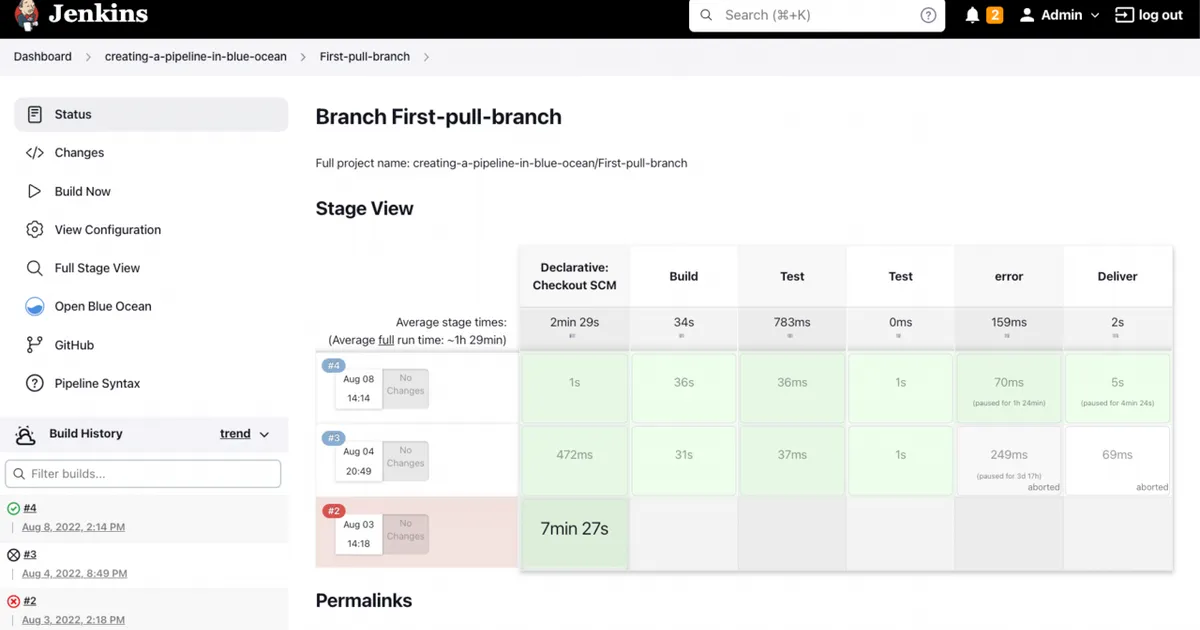
Photo: Kmartens27, CC BY-SA 4.0, via Wikimedia Commons (https://commons.wikimedia.org/wiki/File:Updated-jenkins-view.png)