Fazlur Rahman
Three decisions shape your first month of Python. You must pick a version, a way to study, and a route you can afford. A plan for how to learn Python for beginners should settle these three before the first line of code.
This guide uses official sources only. You get a version support table and a costed comparison of every route. You also get a setup block checked against the Python documentation. For the salary side on its own, see our Python Developer Fresher Salary 2026 figures.
Which Python version should you install first, and how long will it be supported?
Install the current stable release, Python 3.15.2, published on 25 October 2026. Every Python version gets five years of support. Version 3.10 reached end of life on 1 October 2026, yet many tutorials still tell beginners to install it. That version now receives no fixes at all.
Python ships one feature release each October. The Python Developer Guide version table shows how support tapers. A branch gets bugfix builds roughly every two months, then security-only fixes until its end of life date. Versions before 3.13 received 18 months of bugfix builds, and from 3.13 onward the window runs about two years.
| Version | First release | Status in Nov 2026 | Support ends |
|---|---|---|---|
| Python 3.16 | 2027-10-06 planned | In feature phase | 2032-10 |
| Python 3.15 | 2026-10-09 | Bugfix | 2031-10 |
| Python 3.14 | 2025-10-07 | Bugfix | 2030-10 |
| Python 3.13 | 2024-10-07 | Security only | 2029-10 |
| Python 3.12 | 2023-10-02 | Security only | 2028-10 |
| Python 3.10 | 2021-10-04 | End of life | 2026-10-01 |
Version 3.16 is planned for 6 October 2027 and is still in the feature phase, so skip it today.
- Feature phase - the version is still being built, so only pre-release builds exist.
- Bugfix - the version receives bug fixes but no new features.
- Security only - the version receives fixes for security problems until end of life.
- End of life - the version receives no further updates of any kind.
What do the official Python docs skip that every beginner trips on?
The official tutorial runs to 16 chapters. Its opening note says it is written for programmers who are new to Python, not for people new to programming. It also says it does not attempt to cover every feature. That matters for a first-timer.
Chapter 3 of the official Python tutorial uses the interpreter as a calculator, and chapter 4 introduces functions. The virtual environment guide gives the setup commands and two warnings worth reading.
Create the environment, then activate it for your shell:
python -m venv .venvsource .venv/bin/activate.venv\Scripts\activate.bat.venv\Scripts\Activate.ps1Set-ExecutionPolicy -ExecutionPolicy RemoteSigned -Scope CurrentUserpip install -r requirements.txtThe create command is the same on every operating system. The activation line depends on your shell, and the PowerShell setting lets that script run on Windows.
The guide carries two warnings. A virtual environment cannot be moved or copied, because its scripts store absolute paths. Move the project and you create the environment again. The --system-site-packages option lets an environment see every package in the base installation. That hides missing entries in your own list.
The Getting Started page on python.org calls the tutorial a fairly brief tutorial covering the basics. It sends new users to the online documentation for definitive information.
How to learn Python for beginners: which route should you take?
Three routes work for a first Python job. Self-study with the official tutorial costs nothing. A structured course costs money and adds live sessions, lab time and code review. A certification exam tests what you can already do, so it comes last. The table costs each route against 28 course hours.
| Route | Cost in INR | Cost per course hour of 28 | Time and structure | Official anchor |
|---|---|---|---|---|
| Official Python tutorial, self-study | 0 | 0 | Self-paced, 16 chapters | For programmers new to Python |
| Tutorsbot Python Training, batch seat | 18,700 | 668 | 28 live hours, lab time, 5 modules | No prerequisites |
| Tutorsbot Python Training, one-to-one | 24,000 | 857 | 28 live hours, lab time, same curriculum | Same curriculum |
| Tutorsbot Python Training, self-paced | 22,000 | 786 | Self-paced, same 5 modules | Same curriculum |
| PCEP-30-03 certification exam | Not published on the exam page | Not a course | 35 questions in 50 minutes, 70% to pass | Entry level |
Checked November 2026 on the Tutorsbot Python Training course page and the Python Institute exam syllabus.
The tutorial describes itself as a fairly brief tutorial for programmers new to Python. Self-study works when you can hold yourself to a weekly quota.
If the choice still feels hard, the shortest answer to how to learn Python for beginners is to start free. Pay only when you lose the habit.
Which course is best for beginners to learn Python?
Check four things before you pay. Look for a stated lack of prerequisites and live hours you must attend. Look for projects you can show and a published price per hour. A course that lists all four can be compared with the free route.
The Tutorsbot Python Training course runs 28 hours of live sessions across 5 modules and 25 topics. Lab time sits between the sessions. The page states there is no prerequisite and no programming experience needed.
The curriculum covers fundamentals, data structures and algorithms, and object-oriented programming. Automation comes next, with file handling, Excel and PDF work, email, web scraping, Selenium and regular expressions. The capstone includes preparation for the Python Institute's PCEP exam.
The batch format is the cheapest of the three. The Python online training course covers the same 5 modules on your own clock. The one-to-one format gives you the whole course with a single trainer. The curriculum and the certification are the same across formats, so the choice is about how much structure you want.
Two other providers publish Python pages. The LearnSoft Python Training in Chennai page describes a 1.5-month beginner course with 7 modules and 48+ lessons. The Skilbrill Python Programming page lists 96 hours over 16 weeks, live online or in a classroom. Skilbrill gives its fee on request. LearnSoft shows no fee.
Is Python really the easiest language for beginners to learn?
Python's syntax reads close to plain English, so a beginner writes working lines quickly. The hard part is the first ideas, not the language. Variables, loops and functions come before any library. The official tutorial assumes you already program, so a first-timer needs a slower start.
- TIOBE index - a monthly ranking of languages, where Python held first place in November 2026 with 20.86%.
- Stack Overflow Developer Survey 2025 - 54.8% of professional developers used Python, the fourth most used language there.
These figures show demand for Python. They do not show how hard it is to learn.
What can you earn in India once you can write Python?
AmbitionBox puts Python Developer salaries in India at a typical INR 6.8L to INR 7.5L per year. That covers 0 to 4 years of experience. The figures come from 17.3k salaries, updated on 26 November 2026. One salary source is not a promise.
| Measure | Figure | Scope | As of |
|---|---|---|---|
| Typical range, 0-4 years experience | INR 6.8L to INR 7.5L per year | Python Developer, India | 26 Nov 2026 |
| Average salary | INR 7.2L per year, INR 59.7k per month | India, 17.3k salaries | 26 Nov 2026 |
| Highest salary on record | INR 20.8L per year | Python Developer, India | 26 Nov 2026 |
| Top 10% of Python developers | More than INR 9.6L per year | Python Developer, India | 26 Nov 2026 |
Checked November 2026 on AmbitionBox.
The same page listed 1.1k open Python Developer jobs and 444 interviews tracked. What you can build matters more than the exact figure. Read through Top 25 Python Interview Questions 2026 once your scripts work. Then settle the certificate question in ourIs Python Certification Worth It guide.
What should you build to prove you can code?
Build small scripts that finish, rather than collecting half-finished projects. One script a week is often enough to keep the concepts in hand. A script that reads a spreadsheet file and prints a summary teaches files, loops and errors at once.
Write the code first, then check the Python interview questions and answers set.
What should your first month of Python look like?
Give yourself a fixed weekly quota and a small deliverable each week. Install the stable release, then set up a virtual environment. Work through the tutorial in order. Chapter 3 uses the interpreter as a calculator, and chapter 4 introduces functions.
After a month, decide whether you want structure. If you keep missing your quota, a live batch fixes it. For a paper on your resume, look at the Python Institute's PCEP-30-03 exam syllabus. PCEP-30-03 is the Certified Entry-Level Python Programmer exam. It has 35 questions in 50 minutes, a 70% passing score and no prerequisites. The exam page publishes no fee, so ask the provider before you book.
One habit matters more than the rest. Run your code, read the error message, fix it and run it again. Reading error messages is a core skill for any beginner.
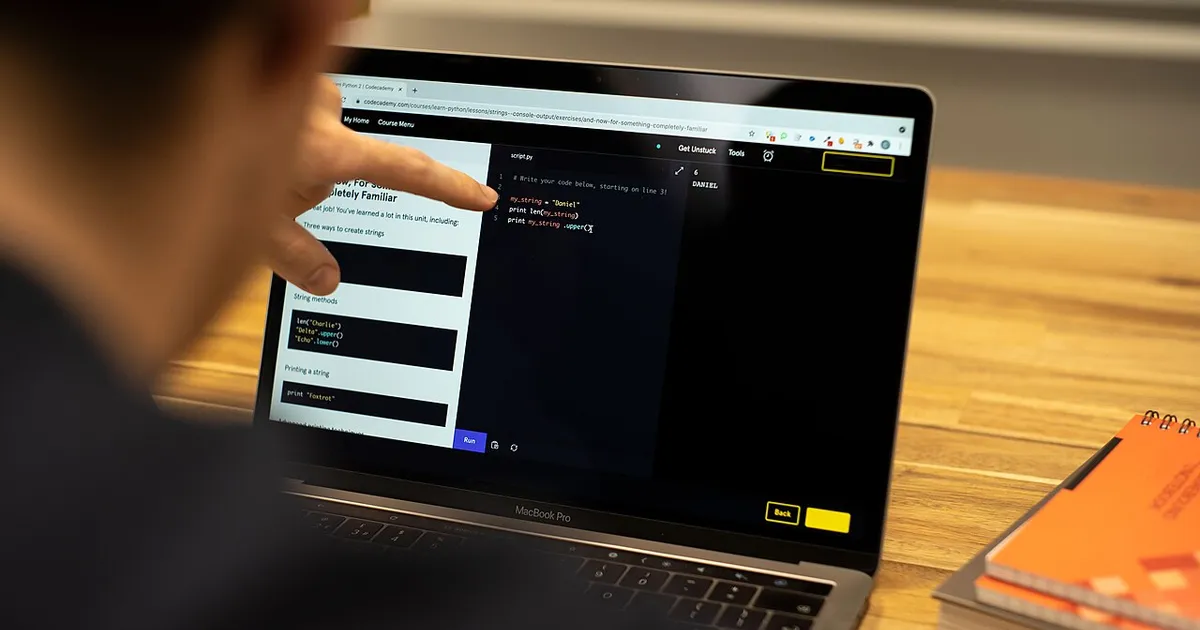
Photo: Preply.com Images, CC BY 2.0, via Wikimedia Commons (https://commons.wikimedia.org/wiki/File:Learning_to_Code.jpg)