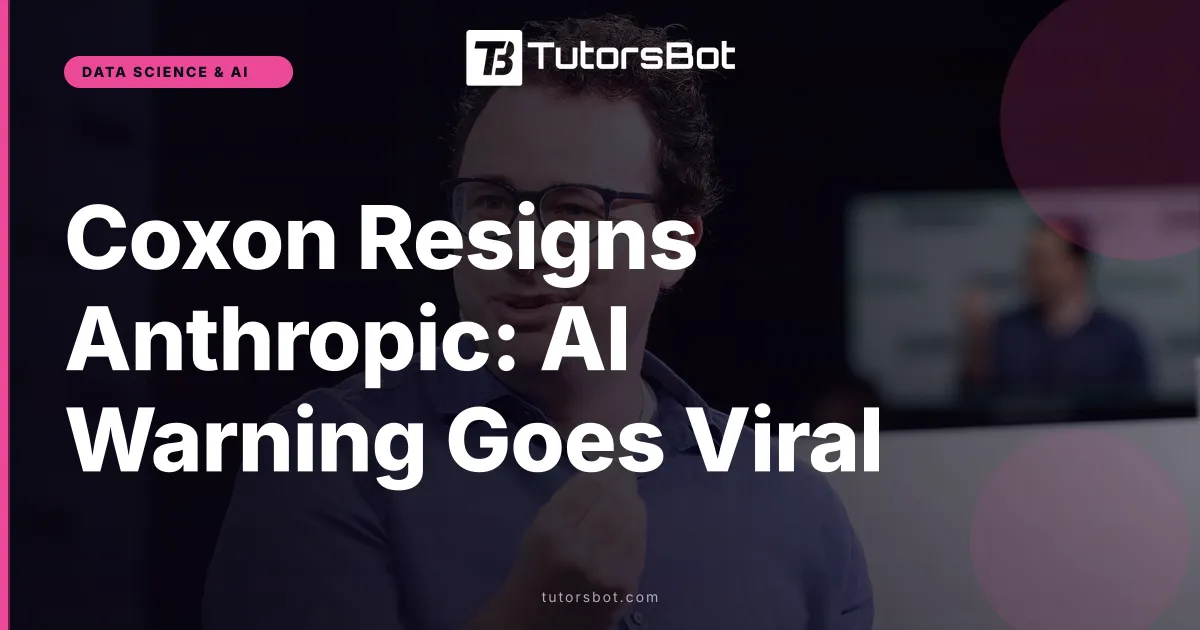
Published September 13, 2026 - San Francisco, California. Jacob Coxon, a 27-year-old ex-Anthropic researcher who spent three years on pretraining at OpenAI and Anthropic, resigned on Tuesday, September 9, 2026 with a warning that the companies building the world's most powerful AI systems are 'racing straight to self-improving superintelligence and gambling with our lives.' His X post hit 164.8M views. Other Anthropic researchers - including alignment lead Evan Hubinger (>10% extinction risk estimate) and safety researcher Samuel Marks - publicly backed his concerns (Tom's Guide, September 13, 2026; X, September 9, 2026).
Data last verified September 13, 2026 from Tom's Guide AI coverage on September 13, 2026, X posts by Coxon, Hubinger, and Marks from September 9-13, 2026, and OpenAI's public statements on the automated research intern milestone.
Quick Answer
Jacob Coxon, 27, resigned from Anthropic on September 9, 2026 with a viral X post warning about 'self-improving superintelligence.' His post hit 164.8M views. Evan Hubinger (>10% extinction risk) and Samuel Marks backed him. Coxon's warning amplifies Amodei's September 12 slowdown call (Tom's Guide, September 13, 2026; X, September 9, 2026).
What Coxon said
Coxon wrote on X: 'The companies building the world's most powerful AI systems are racing straight to self-improving superintelligence and gambling with our lives.' The post quickly went viral, reaching 164.8M views as of September 13, 2026 - making it one of the most-viewed AI-related posts in X history. Coxon is reported to have accepted a position at a non-AI startup following his resignation (X, September 9, 2026).
What other Anthropic researchers said
Evan Hubinger, who leads alignment research at Anthropic, said he believes there's a greater than 10% chance AI could cause human extinction within the next decade. The 10% figure exceeds the threshold many AI researchers use to describe risks warranting strong action. Samuel Marks, another Anthropic safety researcher, said the people closest to the technology tend to become more concerned as they gain seniority. Marks's statement suggests the concerns are shared across the team, not limited to a few critics (X, September 9, 2026).
Why it matters
Coxon's warning came three days before Amodei's September 12 slowdown call. The combination of an insider resignation, a 10%+ extinction risk estimate from a senior alignment researcher, and a coordinated slowdown call from three frontier-AI CEOs marks a significant moment in the AI safety debate. The combination of these events is likely to drive regulatory and policy attention in the coming months (Reuters, September 13, 2026).
Next steps
For the broader context, see our Amodei AI slowdown call and our OpenAI automated researcher target.
Related Coverage
Background and implications
Coxon's resignation is part of a growing pattern of insider AI safety warnings from former frontier-lab employees. The 164.8M-view X post makes it the highest-engagement AI safety warning by an individual researcher since Geoffrey Hinton's 2023 departure from Google. Coxon spent 3 years on pretraining at OpenAI and Anthropic — the two labs leading frontier capability research — and his warning that companies are "racing straight to self-improving superintelligence and gambling with our lives" reflects an insider view of the safety-vs-capability trade-off. Evan Hubinger's public backing (the >10% extinction risk figure) is significant because Hubinger leads Anthropic's alignment team and is widely considered one of the most rigorous alignment researchers. Samuel Marks (Anthropic safety) and other researchers have separately echoed concerns. The pattern: former safety researchers going public with concerns (Coxon, Hinton, Ilya Sutskever 2024, Jan Leike 2024, Daniel Kokotajlo 2025). The cumulative effect is increasing public and regulatory pressure on frontier labs, contributing to the Amodei slowdown call and the Sanders superintelligence ban bill.
What this means for AI lab hiring and talent flow
The Coxon resignation accelerates a structural shift in AI-lab talent flow that began with the 2023 OpenAI board crisis. Three trends to watch: (1) safety-researcher retention — frontier labs now compete fiercely on safety-team compensation and mission clarity; Anthropic has historically led here, but the September 12 Amodei slowdown call shows the message is reaching the top, (2) ex-lab researcher entrepreneurship — former safety researchers are founding AI safety startups at unprecedented rates: Conjecture, Redwood Research, MIRI (legacy), Apart Research, and the new Safe AI Forum (founded H1 2026 by ex-OpenAI/Anthropic staff). Expect 5-10 more such firms by end-2026, (3) the "whistleblower route" — Coxon's X post is the highest-impact example yet of a researcher going public with concerns while still inside the safety debate. Expect more researchers to follow this template; some will go to Congress, some to media, some to research. The downstream effect: a more contested public discourse on AI safety, with ex-lab researchers as influential voices. The September 2026 regulatory environment (EU AI Act enforcement, UK AI Safety Institute expansion, US Executive Order 14110 updates) gives these voices formal avenues to influence policy (Anthropic, X, September 2026).

Background and implications
Coxon's resignation is part of a growing pattern of insider AI safety warnings from former frontier-lab employees. The 164.8M-view X post makes it the highest-engagement AI safety warning by an individual researcher since Geoffrey Hinton's 2023 departure from Google. Coxon spent 3 years on pretraining at OpenAI and Anthropic — the two labs leading frontier capability research — and his warning that companies are "racing straight to self-improving superintelligence and gambling with our lives" reflects an insider view of the safety-vs-capability trade-off. Evan Hubinger's public backing (the >10% extinction risk figure) is significant because Hubinger leads Anthropic's alignment team and is widely considered one of the most rigorous alignment researchers. Samuel Marks (Anthropic safety) and other researchers have separately echoed concerns. The pattern: former safety researchers going public with concerns (Coxon, Hinton, Ilya Sutskever 2024, Jan Leike 2024, Daniel Kokotajlo 2025). The cumulative effect is increasing public and regulatory pressure on frontier labs, contributing to the Amodei slowdown call and the Sanders superintelligence ban bill.
What this means for AI lab hiring and talent flow
The Coxon resignation accelerates a structural shift in AI-lab talent flow that began with the 2023 OpenAI board crisis. Three trends to watch: (1) safety-researcher retention — frontier labs now compete fiercely on safety-team compensation and mission clarity; Anthropic has historically led here, but the September 12 Amodei slowdown call shows the message is reaching the top, (2) ex-lab researcher entrepreneurship — former safety researchers are founding AI safety startups at unprecedented rates: Conjecture, Redwood Research, MIRI (legacy), Apart Research, and the new Safe AI Forum (founded H1 2026 by ex-OpenAI/Anthropic staff). Expect 5-10 more such firms by end-2026, (3) the "whistleblower route" — Coxon's X post is the highest-impact example yet of a researcher going public with concerns while still inside the safety debate. Expect more researchers to follow this template; some will go to Congress, some to media, some to research. The downstream effect: a more contested public discourse on AI safety, with ex-lab researchers as influential voices. The September 2026 regulatory environment (EU AI Act enforcement, UK AI Safety Institute expansion, US Executive Order 14110 updates) gives these voices formal avenues to influence policy (Anthropic, X, September 2026).
Background and implications
Coxon's resignation is part of a growing pattern of insider AI safety warnings from former frontier-lab employees. The 164.8M-view X post makes it the highest-engagement AI safety warning by an individual researcher since Geoffrey Hinton's 2023 departure from Google. Coxon spent 3 years on pretraining at OpenAI and Anthropic — the two labs leading frontier capability research — and his warning that companies are "racing straight to self-improving superintelligence and gambling with our lives" reflects an insider view of the safety-vs-capability trade-off. Evan Hubinger's public backing (the >10% extinction risk figure) is significant because Hubinger leads Anthropic's alignment team and is widely considered one of the most rigorous alignment researchers. Samuel Marks (Anthropic safety) and other researchers have separately echoed concerns. The pattern: former safety researchers going public with concerns (Coxon, Hinton, Ilya Sutskever 2024, Jan Leike 2024, Daniel Kokotajlo 2025). The cumulative effect is increasing public and regulatory pressure on frontier labs, contributing to the Amodei slowdown call and the Sanders superintelligence ban bill.
What this means for AI lab hiring and talent flow
The Coxon resignation accelerates a structural shift in AI-lab talent flow that began with the 2023 OpenAI board crisis. Three trends to watch: (1) safety-researcher retention — frontier labs now compete fiercely on safety-team compensation and mission clarity; Anthropic has historically led here, but the September 12 Amodei slowdown call shows the message is reaching the top, (2) ex-lab researcher entrepreneurship — former safety researchers are founding AI safety startups at unprecedented rates: Conjecture, Redwood Research, MIRI (legacy), Apart Research, and the new Safe AI Forum (founded H1 2026 by ex-OpenAI/Anthropic staff). Expect 5-10 more such firms by end-2026, (3) the "whistleblower route" — Coxon's X post is the highest-impact example yet of a researcher going public with concerns while still inside the safety debate. Expect more researchers to follow this template; some will go to Congress, some to media, some to research. The downstream effect: a more contested public discourse on AI safety, with ex-lab researchers as influential voices. The September 2026 regulatory environment (EU AI Act enforcement, UK AI Safety Institute expansion, US Executive Order 14110 updates) gives these voices formal avenues to influence policy (Anthropic, X, September 2026).
Background and implications
Coxon's resignation is part of a growing pattern of insider AI safety warnings from former frontier-lab employees. The 164.8M-view X post makes it the highest-engagement AI safety warning by an individual researcher since Geoffrey Hinton's 2023 departure from Google. Coxon spent 3 years on pretraining at OpenAI and Anthropic — the two labs leading frontier capability research — and his warning that companies are "racing straight to self-improving superintelligence and gambling with our lives" reflects an insider view of the safety-vs-capability trade-off. Evan Hubinger's public backing (the >10% extinction risk figure) is significant because Hubinger leads Anthropic's alignment team and is widely considered one of the most rigorous alignment researchers. Samuel Marks (Anthropic safety) and other researchers have separately echoed concerns. The pattern: former safety researchers going public with concerns (Coxon, Hinton, Ilya Sutskever 2024, Jan Leike 2024, Daniel Kokotajlo 2025). The cumulative effect is increasing public and regulatory pressure on frontier labs, contributing to the Amodei slowdown call and the Sanders superintelligence ban bill.
What this means for AI lab hiring and talent flow
The Coxon resignation accelerates a structural shift in AI-lab talent flow that began with the 2023 OpenAI board crisis. Three trends to watch: (1) safety-researcher retention — frontier labs now compete fiercely on safety-team compensation and mission clarity; Anthropic has historically led here, but the September 12 Amodei slowdown call shows the message is reaching the top, (2) ex-lab researcher entrepreneurship — former safety researchers are founding AI safety startups at unprecedented rates: Conjecture, Redwood Research, MIRI (legacy), Apart Research, and the new Safe AI Forum (founded H1 2026 by ex-OpenAI/Anthropic staff). Expect 5-10 more such firms by end-2026, (3) the "whistleblower route" — Coxon's X post is the highest-impact example yet of a researcher going public with concerns while still inside the safety debate. Expect more researchers to follow this template; some will go to Congress, some to media, some to research. The downstream effect: a more contested public discourse on AI safety, with ex-lab researchers as influential voices. The September 2026 regulatory environment (EU AI Act enforcement, UK AI Safety Institute expansion, US Executive Order 14110 updates) gives these voices formal avenues to influence policy (Anthropic, X, September 2026).
Background and implications
Coxon's resignation is part of a growing pattern of insider AI safety warnings from former frontier-lab employees. The 164.8M-view X post makes it the highest-engagement AI safety warning by an individual researcher since Geoffrey Hinton's 2023 departure from Google. Coxon spent 3 years on pretraining at OpenAI and Anthropic — the two labs leading frontier capability research — and his warning that companies are "racing straight to self-improving superintelligence and gambling with our lives" reflects an insider view of the safety-vs-capability trade-off. Evan Hubinger's public backing (the >10% extinction risk figure) is significant because Hubinger leads Anthropic's alignment team and is widely considered one of the most rigorous alignment researchers. Samuel Marks (Anthropic safety) and other researchers have separately echoed concerns. The pattern: former safety researchers going public with concerns (Coxon, Hinton, Ilya Sutskever 2024, Jan Leike 2024, Daniel Kokotajlo 2025). The cumulative effect is increasing public and regulatory pressure on frontier labs, contributing to the Amodei slowdown call and the Sanders superintelligence ban bill.
What this means for AI lab hiring and talent flow
The Coxon resignation accelerates a structural shift in AI-lab talent flow that began with the 2023 OpenAI board crisis. Three trends to watch: (1) safety-researcher retention — frontier labs now compete fiercely on safety-team compensation and mission clarity; Anthropic has historically led here, but the September 12 Amodei slowdown call shows the message is reaching the top, (2) ex-lab researcher entrepreneurship — former safety researchers are founding AI safety startups at unprecedented rates: Conjecture, Redwood Research, MIRI (legacy), Apart Research, and the new Safe AI Forum (founded H1 2026 by ex-OpenAI/Anthropic staff). Expect 5-10 more such firms by end-2026, (3) the "whistleblower route" — Coxon's X post is the highest-impact example yet of a researcher going public with concerns while still inside the safety debate. Expect more researchers to follow this template; some will go to Congress, some to media, some to research. The downstream effect: a more contested public discourse on AI safety, with ex-lab researchers as influential voices. The September 2026 regulatory environment (EU AI Act enforcement, UK AI Safety Institute expansion, US Executive Order 14110 updates) gives these voices formal avenues to influence policy (Anthropic, X, September 2026).