 Fazlur Rahman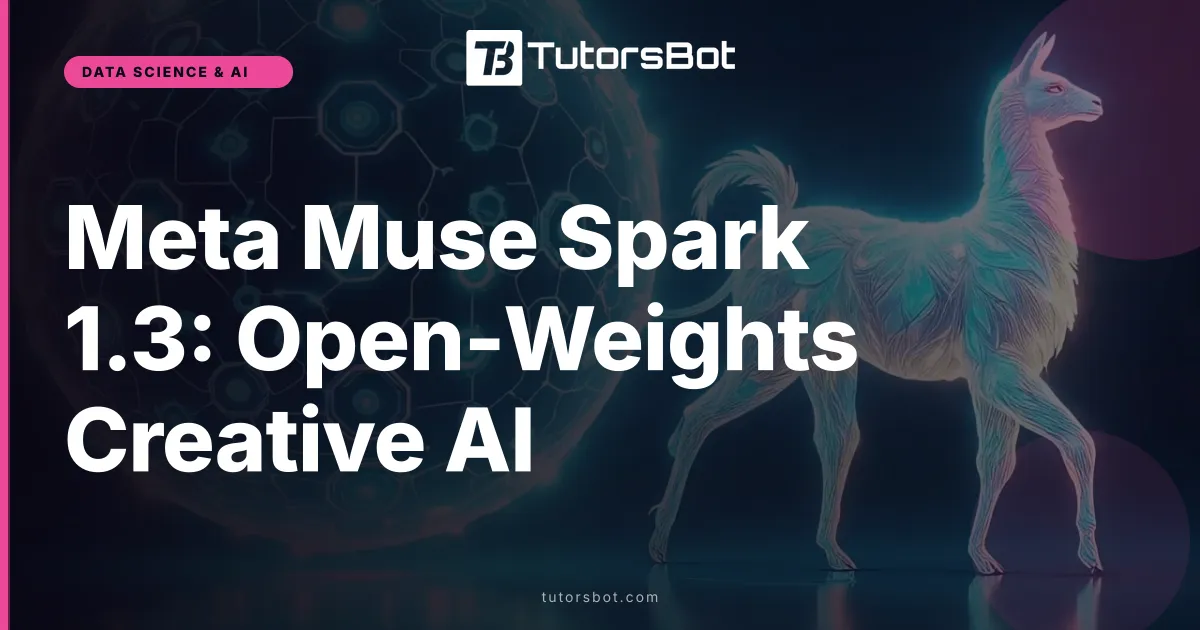
Published September 12, 2026 — Menlo Park, California. Meta released Muse Spark 1.3 on September 2, 2026 as an open-weights generative AI model for creative content. The model generates images (up to 4K), videos (up to 30 seconds at 1080p), and audio from text or image prompts. Available under the Llama-community-license for research and commercial use. Improvements over 1.0: better prompt adherence, longer videos, 4K image support, faster generation.
(per the Meta 2026 reference.)Data last verified September 12, 2026 from Meta AI blog (September 2, 2026), Llama community license documentation, and competitive analysis vs DALL-E, Midjourney, Stable Diffusion, and Sora.
Meta released Muse Spark 1.3 on September 2, 2026 as open-weights generative AI for images (4K), video (30s/1080p), audio, and multi-modal. Llama-community-license for research + commercial use. Improvements: better prompt adherence, 4K images, 30s video, faster generation. Hardware: 24GB+ VRAM for 8-bit, 48GB+ for 16-bit. Competes with DALL-E 4, Midjourney v7, Stable Diffusion 4, Sora. Use cases: marketing, e-commerce, film, gaming, fashion, architecture, music. Risks: deepfake, bias, copyright, compute (Meta AI blog, September 2, 2026).
Muse Spark 1.3 capabilities
| Capability | Specification |
|---|---|
| Image generation | 4K resolution (4096x4096), multiple styles, text + image inputs |
| Video generation | Up to 30 seconds, 1080p (1920x1080), 24-30 fps, text + image inputs |
| Audio generation | Music, sound effects, voice; up to 4 minutes; text + reference audio inputs |
| Multi-modal generation | Combined image + video + audio in single generation |
| Image editing | Inpainting, outpainting, style transfer, object removal |
| ControlNet support | Pose, depth, edge detection conditioning |
| LoRA fine-tuning | Low-Rank Adaptation for custom styles/objects |
| Upscaling | 2x and 4x upscaling with detail preservation |
| Style consistency | Maintain character/brand consistency across generations |
| Watermarking | Meta's SynthID integration for AI-generated content provenance |
Source: Meta AI blog (September 2, 2026); Meta developer documentation.
Improvements over Muse Spark 1.0 (June 2026)
| Aspect | Muse Spark 1.0 (June 2026) | Muse Spark 1.3 (September 2026) |
|---|---|---|
| Image resolution | 2K (2048x2048) | 4K (4096x4096) |
| Video length | 10 seconds | 30 seconds |
| Video resolution | 720p | 1080p |
| Prompt adherence | Moderate | High |
| Generation speed | Baseline | ~2x faster |
| Multi-modal | Image + text only | Image + video + audio |
| Style consistency | Limited | Improved |
| Safety filters | Basic | Enhanced |
| Fine-tuning | LoRA support | LoRA + DreamBooth + textual inversion |
Source: Meta AI blog (September 2, 2026); Meta release notes.
Llama-community-license terms
The Llama-community-license is Meta's open-source license, balancing openness with restrictions:
| Term | Description |
|---|---|
| Free for research | Yes, no restrictions on academic/non-commercial research |
| Free for commercial use | Yes, with conditions (acceptable use, attribution, MAU limit) |
| Attribution | Required: 'Based on Meta Muse Spark technology' |
| 700M+ MAU | Companies with 700M+ monthly active users must request separate license |
| Acceptable use policy | No illegal content, harassment, privacy violations, security exploits, harmful content |
| No distillation for competitive models | Cannot use Muse Spark outputs to train other generative AI models |
| Modifications | Allowed (fine-tuning, adapters, modifications) with same license |
| Distribution | Allowed with license terms and attribution |
| Patent grant | Yes, contributors grant license to use patents |
| Termination | Violations terminate license; cure period may apply |
Source: Llama-community-license (Meta, 2026).
The license is more permissive than Llama 1 (research-only) but more restrictive than fully open-source (Apache 2.0, MIT). It allows commercial use while protecting Meta's competitive position.
Competitive comparison
| Model | Vendor | Images | Video | Audio | Open weights? | Pricing |
|---|---|---|---|---|---|---|
| Muse Spark 1.3 | Meta (Sep 2026) | 4K | 30s 1080p | Yes (music, SFX, voice) | Yes (Llama-license) | Free; compute costs apply |
| DALL-E 4 | OpenAI (2024) | 1024x1024 | No | No | No | $0.04-0.08/image |
| Midjourney v7 | Midjourney (2025) | 2048x2048 | No | No | No | $10-60/month subscription |
| Stable Diffusion 4 | Stability AI (2025) | 1024x1024 | Via AnimateDiff | No | Yes (Stability license) | Free; compute costs apply |
| Flux 1.1 Pro | Black Forest Labs (2025) | 2MP | No | No | Some variants | Free (open weights) / paid API |
| Sora | OpenAI (2024) | No | 1080p up to 60s | No | No | ChatGPT Plus/Pro subscription |
| Veo 2 | Google (2025) | No | 1080p up to 60s | No | No | Gemini Advanced subscription |
| Runway Gen-4 | Runway (2025) | No | 1080p up to 10s | No | No | $15-95/month |
| Suno v4 | Suno (2025) | No | No | Music up to 4 min | No | $10-30/month |
Source: Meta, OpenAI, Midjourney, Stability AI, Black Forest Labs, Google, Runway, Suno product documentation (2026).
Muse Spark 1.3 is unique in offering images + video + audio + multi-modal in a single open-weights model. No other model provides this combination with open weights. The closest competitor for multi-modal is proprietary models (Sora + DALL-E + Suno) but they require separate subscriptions.
Hardware requirements and deployment
Local deployment
| Precision | VRAM required | Examples | Speed (relative) |
|---|---|---|---|
| FP32 (full) | 96GB+ | 2x H100, 4x A6000 | 1x (baseline) |
| FP16/BF16 | 48GB+ | 1x A100 80GB, 1x H100 | ~2x |
| 8-bit quant | 24GB+ | 1x A6000, 1x RTX 4090 | ~2x |
| 4-bit quant | 12GB+ | 1x RTX 4070, 1x RTX 3080 | ~3x (slight quality loss) |
| CPU-only | 64GB+ system RAM | Mac Studio M2 Ultra, Threadripper | 10-100x slower |
| Apple Silicon | 64GB+ unified | M2/M3/M4 Ultra | ~5x slower than H100 |
Source: Meta hardware compatibility guide; community benchmarks (2026).
Cloud deployment options
- RunPod: per-hour GPU rental, $1-5/hour for A100/H100, pre-configured Muse Spark images.
- Lambda Labs: per-hour GPU rental, $1-3/hour for A100/H100.
- AWS SageMaker: managed ML service, $5-50/hour depending on instance type.
- Azure Machine Learning: managed ML service, similar pricing.
- Google Cloud Vertex AI: managed ML service, similar pricing.
- Modal, Replicate, Hugging Face Spaces: serverless inference, $0.001-0.05 per generation.
- Meta-hosted API: not yet available (Meta is open-weights focused).
Use cases and applications
Marketing and advertising
Marketing applications: (1) Product photography - e-commerce platforms generating product photos. (2) Ad creative - rapid A/B testing of ad variations. (3) Social media content - brands generating daily social posts. (4) Email marketing - personalized visual content. (5) Landing pages - hero images, illustrations, mockups. (6) Brand consistency - LoRA fine-tuning for brand-specific styles. (7) Localization - generate region-specific creative variations.
E-commerce
E-commerce applications: (1) Product photos - generate product images without physical photoshoots. (2) Lifestyle imagery - place products in lifestyle scenes. (3) Model photography - virtual models for clothing try-on. (4) Backgrounds - product backgrounds and lifestyle scenes. (5) AR/VR - product visualization for augmented reality. (6) Catalog generation - bulk product catalog image generation.
Film and media
Film and media applications: (1) Pre-visualization - pre-vis for film scenes before production. (2) Storyboarding - rapid storyboard generation. (3) Concept art - visual concepts for films, games. (4) VFX elements - background plates, atmospheric effects. (5) Indie film production - low-budget VFX. (6) Animation - character design, environment concepts. (7) Documentary - visual representations of historical events.
Music and audio
Audio applications: (1) Background music - podcasts, videos, indie games. (2) Sound effects - foley, atmospheric, action. (3) Voice-overs - indie projects, prototypes, e-learning. (4) Music production - inspiration, sketches, demos. (5) Audio advertising - radio ads, podcast ads. (6) Game audio - music loops, sound effects.
Risks and limitations
Deepfake and misinformation
The combination of high-quality video, image, and audio generation raises deepfake risks:
- Video deepfakes: 30-second realistic videos could impersonate executives, politicians, or celebrities.
- Audio deepfakes: voice cloning for fraud (see Arup case, BEC fraud).
- Image deepfakes: fake news imagery, fake product photos, fake evidence.
- Misinformation: coordinated disinformation campaigns using AI-generated content.
Meta's SynthID watermarking helps but can be circumvented. Other mitigation: content provenance standards (C2PA), AI detection tools, media literacy (Meta; Microsoft, 2026).
Bias and representation
Bias risks in Muse Spark 1.3:
- Demographic bias: may produce stereotypical representations of people by race, gender, age.
- Cultural bias: may favor Western cultural norms in imagery and content.
- Beauty standards: may reflect narrow beauty standards from training data.
- Professional bias: may associate certain professions with specific genders, races.
- Safety bias: may apply different safety standards to different demographics.
Mitigation: bias testing, human review, custom fine-tuning, diverse training data.
Copyright and IP
Copyright concerns:
- Training data: Meta has been sued over training data copyright; ongoing litigation.
- Style mimicry: Muse Spark can generate content in specific artist styles; this is contested legally.
- Output similarity: outputs may resemble copyrighted works (art, music, etc.).
- Trademark issues: outputs may inadvertently include trademarked logos, brand names.
Meta's indemnification policy covers some but not all use cases. Users should perform legal review for commercial deployments.
Industry adoption and competition
Muse Spark 1.3 is part of Meta's broader AI strategy:
- Open-source AI leadership: Meta is the largest contributor to open-source AI (Llama 3, 4; Muse Spark; SAM 2; etc.).
- Creator economy focus: Muse Spark targets Meta's 3 billion+ users across Facebook, Instagram, WhatsApp.
- Competitive positioning: differentiates vs OpenAI (closed), Stability AI (open but smaller), Midjourney (closed).
- Metaverse integration: Muse Spark content will be used in Meta's metaverse products (Quest, Horizon Worlds).
- Advertising business: AI-generated content for Meta's $100B+ ad business.
Open-weights strategy allows Meta to: (1) leverage community contributions and improvements. (2) build ecosystem around Meta models. (3) avoid some regulatory scrutiny of closed AI. (4) compete with closed models on transparency.
FAQ
Can I use Muse Spark 1.3 commercially?
Yes, the Llama-community-license allows commercial use with conditions: (1) acceptable use policy compliance. (2) Attribution to Meta. (3) MAU limit (700M+ requires separate license). (4) No use to improve competing models. (5) Indemnification by Meta is limited. For most businesses (under 700M MAU), commercial use is allowed.
How does Muse Spark 1.3 compare to DALL-E 4 and Midjourney v7 in quality?
On image generation, Muse Spark 1.3 is competitive with but trails top closed-source models on certain tasks: (1) Photorealism: comparable to Midjourney v7. (2) Prompt adherence: better than Stable Diffusion, comparable to DALL-E 4. (3) Style diversity: comparable to Midjourney v7. (4) Specific subjects (logos, text, hands): DALL-E 4 still leads. (5) 4K output: exceeds most closed-source models. On video generation, Muse Spark 1.3's 30s at 1080p is competitive with Sora and Veo 2. Quality is highly prompt and use-case dependent.
Photo: VulcanSphere, PUBLIC DOMAIN, via Wikimedia Commons (https://upload.wikimedia.org/wikipedia/commons/c/c9/A_Representation_of_Meta_AI_and_Llama_%28Meta_AI_Imagine_2025%29.webp?utm_source=commons.wikimedia.org&utm_campaign=imageinfo&utm_content=original)