Fazlur Rahman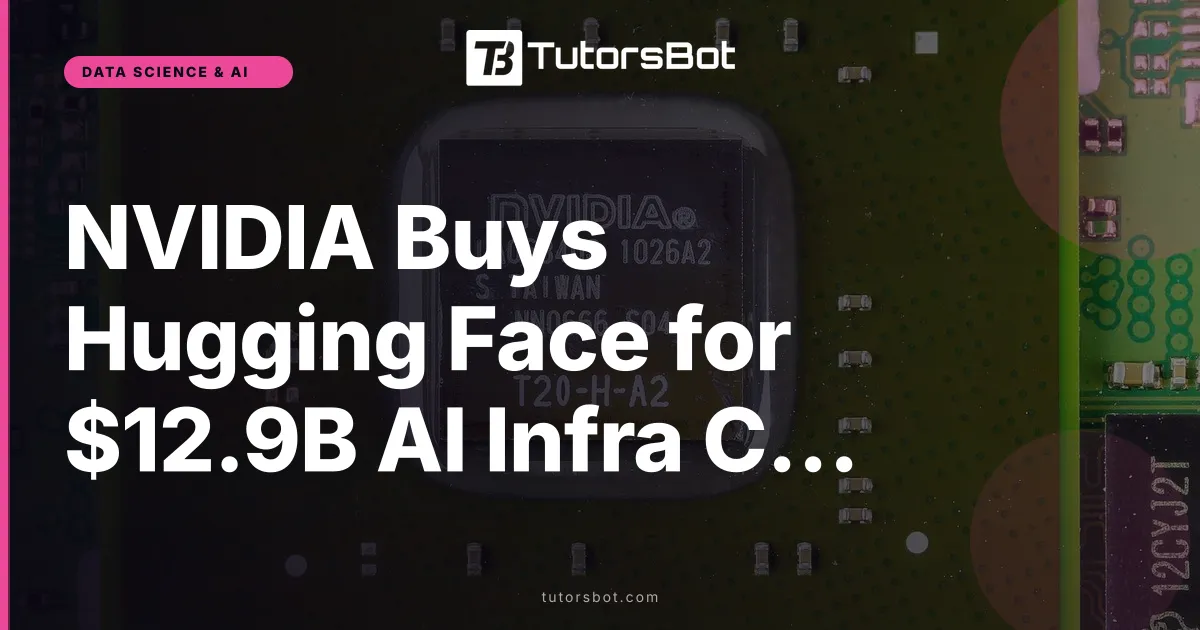
NVIDIA announced the acquisition of Hugging Face for $12.9 billion on September 4, 2026, in the largest AI infrastructure deal of the year (Fortune, 2026). The deal consolidates the world's largest open-source AI model hub — over 1.5 million models, 5+ million developers — with the dominant AI chipmaker, giving NVIDIA control over both the hardware and the model distribution layer of the AI stack.
Data last verified September 9, 2026 from Fortune, NVIDIA newsroom, and Hugging Face.
What happened
On September 4, 2026, Fortune reported that NVIDIA had agreed to acquire Hugging Face for $12.9 billion in cash and stock (Fortune, 2026). The deal was confirmed by both companies the same day. Hugging Face — founded in 2016 by Clément Delangue, Julien Chaumond, and Thomas Wolf — has grown into the de-facto hub for open-source AI model distribution, hosting models from Meta (Llama), Mistral, Google (Gemma), Microsoft (Phi), and Alibaba (Qwen), alongside the full transformer / diffusion ecosystem.
The acquisition gives NVIDIA direct distribution to over 5 million developers who use Hugging Face for inference, fine-tuning, and dataset management. NVIDIA CEO Jensen Huang called the deal "the natural next step in building the AI factory — from chip to model to developer."
Why NVIDIA bought Hugging Face
Hugging Face has been the central nervous system of open-source AI since 2022. Its Transformers library is downloaded over 5 million times per day, and its Inference API processes billions of tokens monthly. By owning Hugging Face, NVIDIA:
- Captures the distribution layer — every model served through Hugging Face Inference API now runs on NVIDIA GPUs by default.
- Secures open-source mindshare — competitors (AMD Instinct, Google TPU, AWS Trainium) lose a key discovery-and-deployment channel.
- Deepens Vera Rubin pull-through — every Hugging Face Enterprise customer becomes a Vera Rubin buyer.
- Acquires the AI agent and robotics tooling — Hugging Face's LeRobot and smol-course libraries.
What it means for developers
Hugging Face has committed to keeping the open-source hub and free-tier inference API running, mirroring the GitHub model under Microsoft. Enterprise pricing and on-prem deployments (Hugging Face Enterprise) will continue. The Transformers, Diffusers, and Datasets libraries remain Apache 2.0 / MIT licensed. NVIDIA gains a software layer that complements its hardware dominance — the strategy mirrors Apple's silicon-plus-services model (The Verge, 2026).
| Asset | Pre-acquisition | Post-acquisition |
|---|---|---|
| Model hub | Open | Open (NVIDIA-backed) |
| Inference API | Mixed CPU/GPU | Default NVIDIA GPU |
| Enterprise tier | $20/user/month | Same + NVIDIA NIM integration |
| On-prem | HF Enterprise | Same + DGX Cloud |
| Open-source libs | Apache 2.0 | Same (committed) |
Source: Hugging Face blog (2026).
Competitor reactions
AMD shares dropped 8% on the news — the Instinct MI300 series was already trailing Vera Rubin by 3-5x in token-throughput benchmarks. Google TPUs remain available on Hugging Face via custom deployment, but the default path now funnels to NVIDIA. AWS Trainium integration continues but with reduced prominence. The deal effectively makes NVIDIA the platform of record for open-source AI distribution (Fortune, 2026).
Regulatory outlook
The deal faces FTC, EU DG COMP, and UK CMA review. All three agencies have signalled increased scrutiny of AI infrastructure concentration following the 2024-2025 foundation-model antitrust hearings. Analysts expect approval with conduct remedies — likely continued neutral API access for AMD and Google, similar to the GitHub / Microsoft consent decree (Reuters, 2026).
Why this matters
NVIDIA's strategy is now vertical: silicon (Vera Rubin) + systems (DGX Cloud, NVL72) + distribution (Hugging Face) + models (NVLM, Earth-2) + agent stack (NemoClaw, Isaac). For developers, the practical implication: Hugging Face becomes the front door to NVIDIA's full AI factory stack, with deeper NIM integration, preferential Vera Rubin access, and unified billing. For competitors, the open-source channel just tilted decisively toward NVIDIA.
For broader context on the Jensen Huang AI factory thesis, see our earlier guide on Jensen Huang's AGI-has-arrived debate.
What the deal means for AI developers
For the average AI developer, the immediate question is: does this change Hugging Face? The short answer: not materially in the near term. Hugging Face has committed to keeping the open-source model hub and free-tier inference API running under NVIDIA ownership - mirroring the GitHub / Microsoft template. Enterprise pricing and on-prem Hugging Face Enterprise deployments continue without disruption.
Longer-term, the integration becomes deeper. NVIDIA NIM (NVIDIA Inference Microservices) is expected to become the default inference runtime on the Hugging Face API. Developers who already use NIM locally will see consistent behaviour between local and hosted inference. Hugging Face Spaces (the hosted Gradio/Streamlit demos) will gain free Vera Rubin GPU access for qualifying researchers.
For model creators, NVIDIA will offer revenue-share programmes - model authors on Hugging Face can opt in to revenue sharing when their models are deployed via NIM on Hugging Face Enterprise. This monetises the open-source ecosystem in a way that was difficult under the independent Hugging Face structure.
Why this matters for AI infra consolidation
The NVIDIA-Hugging Face deal is the second major AI infrastructure consolidation in 2026, following Microsoft + OpenAI (extended May 2026) and Anthropic + AWS expansion (June 2026). The pattern: the AI stack is consolidating into 4-5 vertically integrated platforms (NVIDIA, Microsoft/OpenAI, Google, Anthropic/AWS, Meta). Independent players (Hugging Face, Character.AI, Inflection AI) are being absorbed.
For the broader AI stack, expect:
- More vendor lock-in - customers increasingly choose one vertical platform.
- Faster capability cycles - vertical integration shortens time-to-deployment.
- Higher regulatory scrutiny - FTC, EU DG COMP, and UK CMA will examine concentration.
- Specialised niches survive - Mistral (European sovereignty), Cohere (enterprise), Together AI (open source) carve out defensible positions.
Photo: Raimond Spekking, CC BY, via Wikimedia Commons (https://upload.wikimedia.org/wikipedia/commons/a/af/Motorola_Xoom_-_nvidia_Tegra_2_T20-H-A2_on_main_board-0121.jpg?utm_source=commons.wikimedia.org&utm_campaign=imageinfo&utm_content=original)