Fazlur Rahman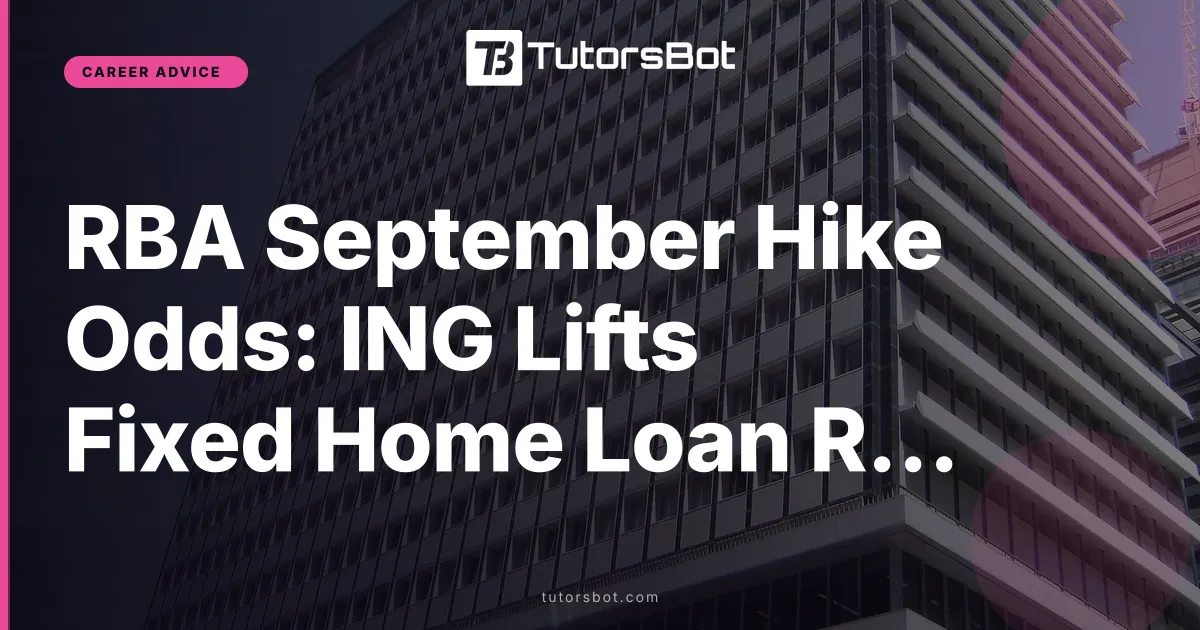
Last verified: Sep 16, 2026.
At a glance
- ING fixed rate hike: +0.2% on Sep 16, 2026
- RBA cash rate: 4.35% (3 hikes earlier in 2026)
- September 28-29 hike odds: 75% priced
- Expected new cash rate: 4.60% (15-year high)
- Citi peak forecast: 4.85%, first cut Q4 2027
- July CPI: 3.5% headline, 3.6% trimmed mean
- Australian variable mortgage: 6.5–6.9% avg
ING's September 16 fixed rate hike: a "clear sign"
ING lifted fixed home loan rates by 0.2 percentage points on September 16, 2026 — sending a clear signal that the bank expects the RBA to hike.
ING announced that it would increase fixed interest rates for owner-occupier and investor home loans by 0.2 percentage points, effective immediately on all fixed rate loans settling from that day. Richard Whitten, money and home loans expert at Finder, called it a "clear sign" the bank expected the RBA Board to raise the cash rate soon. Whitten said ING was making sure they weren't locking customers into rates that were "too competitive and out of step with the market" (Nine.com.au, September 16, 2026).
"They lower fixed rates when they anticipate interest rates to fall further, and lift them when they expect rates rising," Whitten said. The 0.2 percentage point increase applies to ING's full fixed-rate range across owner-occupier and investor home loans, with the changes effective immediately.
The RBA's September 28-29 hike: 75% probability
Markets are pricing a 75% probability that the RBA will lift the cash rate to 4.60% — a 15-year high.
The RBA next meets on September 28-29, 2026, and markets are currently pricing at least a 75% chance that the cash rate will rise to 4.6%. They are pricing a virtual certainty of two rate hikes by February 2027, with a 50/50 chance of a third by mid-next year. A cash rate of 4.85% would be the highest since rates were slashed over late 2008 in response to the global financial crisis (ABC News, September 15, 2026).
Citi senior economist and analyst Faraz Syed has predicted two more rate rises before 2027 rolls around. "This view is driven by a two-speed economy, where a deepening housing correction is offset by an AI-related investment boom that is adding to capacity constraints," Syed said. "Anemic productivity, a tight labour market, and elevated oil prices likely mean inflation will remain stubbornly high, with our Q3 trimmed-mean CPI forecast at 1 per cent." Syed has lifted his prediction for where rates would peak before falling to 4.85% from 4.6%, with his first rate cut forecast pushed out to Q4 2027.
The Big Four split on RBA timing
Australia's Big Four banks are divided on whether the RBA hikes in September or November.
Earlier this month, all four of Australia's Big Four — plus Macquarie Bank — finally got on the same page forecasting another rate rise before year's end, but the lenders were divided on timing. National Australia Bank is anticipating rates to go up in September, while ANZ, Commonwealth Bank of Australia, and Westpac have placed their bets on November (Australian Broker, September 16, 2026).
Harry Ottley, an economist at CBA, said the bank still expects rates to remain on hold until November. "But certainly the September meeting now is quite well priced by financial markets, and there's a very real chance that they can increase rates in September," Ottley told Australian Broker. "I think the nail in the coffin is probably that they'll have to raise interest rates again. The question is when, whether it'll be September or November." Westpac is forecasting the RBA will hold off until November, with economist Illiana Jain saying, "We are expecting rate rises in November. We think the RBA is going to take their time to assess the data."
Why is the RBA so hawkish in 2026?
Deputy Governor Andrew Hauser: "People are furious about inflation."
The RBA's hawkishness reflects stubbornly high inflation. The July consumer price index showed headline CPI at 3.5% and trimmed mean at 3.6% — both above the RBA's 2-3% target range. Deputy Governor Andrew Hauser said on September 14 that Australia's economy has "one big problem and that's inflation" and warned that the RBA may need to raise rates further to tame price increases. Hauser added: "We will raise interest rates further than otherwise we would need to do so" (ABC News, September 15, 2026).
The RBA's own community survey found that two-thirds of Australians put inflation as one of their top three economic concerns. The same survey turned up another finding that has the Reserve Bank worried: only 25% of respondents assessed correctly that higher interest rates would ultimately lead to lower inflation, while more than half indicated that higher interest rates would lead to higher inflation.
Three near-term datapoints. First, the September 30 Australian Bureau of Statistics CPI release — the August CPI data point will heavily influence the November 5 RBA decision. A print below 3.3% would likely pull September hike odds below 50%. Second, the September 28-29 RBA decision itself — markets are pricing 75% odds of a hike, but the language around future moves will determine whether November is also live. Third, the November 5 RBA decision — if September delivers a hike and October CPI confirms sticky inflation, November is highly likely to deliver a second hike.
| Australian rate path forecast (Sep 16, 2026) | Source | Forecast |
|---|---|---|
| September 28-29 hike | Markets | 75% probability, +25 bps |
| November 5 hike | Markets | Virtual certainty if Sep hikes |
| Peak cash rate | Citi | 4.85% |
| Peak cash rate | Macquarie | 4.6% in 2026 |
| First rate cut | Citi | Q4 2027 |
| July CPI (headline) | ABS | 3.5% |
| July CPI (trimmed mean) | ABS | 3.6% |
Photo: Danausi, PUBLIC DOMAIN, via Wikimedia Commons (https://upload.wikimedia.org/wikipedia/commons/7/76/RBA_Building.jpg?utm_source=commons.wikimedia.org&utm_campaign=imageinfo&utm_content=original)