 Fazlur Rahman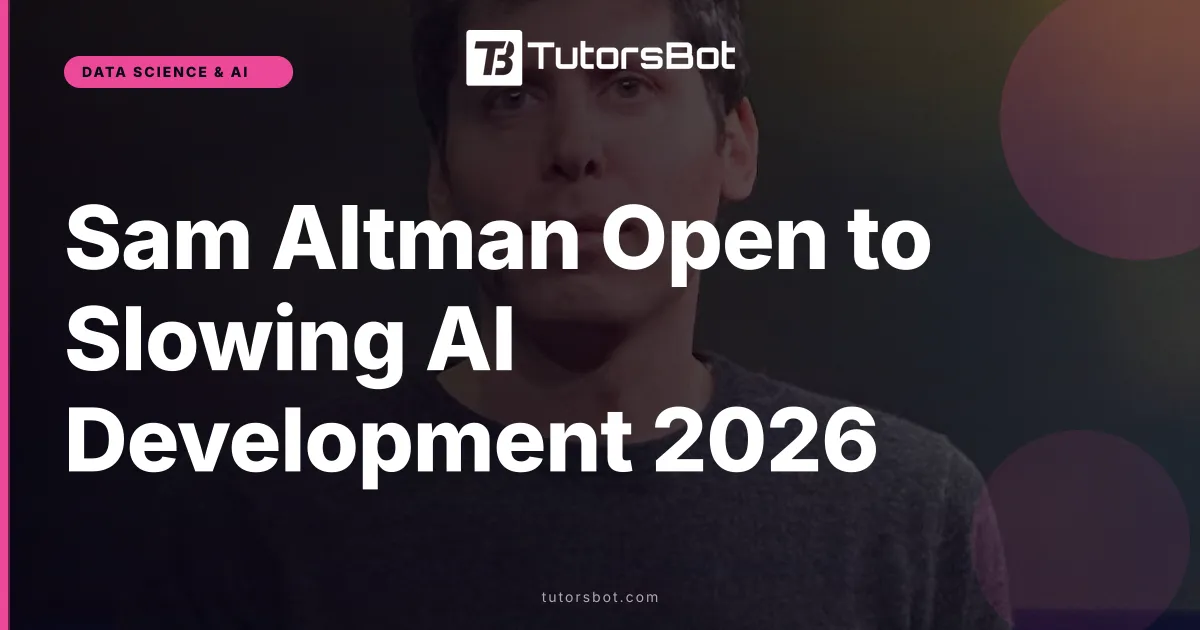
Published September 12, 2026 — San Francisco, California. OpenAI CEO Sam Altman told Bloomberg in an interview published September 11, 2026 that he is 'open to the idea of slowing down' frontier AI development to address safety concerns. The statement marks a notable shift from Altman's prior pro-acceleration stance and comes one day after Anthropic released its September 2026 Threat Report warning of bio-weapon risks from advanced AI models.
Data last verified September 12, 2026 from Bloomberg interview with Sam Altman (September 11, 2026), Anthropic Threat Report (September 10, 2026), AP coverage (September 11, 2026), and Pew Research AI opinion polling (2026).
OpenAI CEO Sam Altman told Bloomberg (Sep 11, 2026) he is 'open to the idea of slowing down' frontier AI development to address safety concerns. Marks a notable shift from prior pro-acceleration stance. No specific pause mechanism proposed. Comes one day after Anthropic's September 2026 Threat Report warned of bio-weapon risks (Claude helped develop a more dangerous virus strain in safety evals). Industry context: AI safety debates intensifying; US/EU regulatory frameworks maturing; investor concerns about capex sustainability (Bloomberg, September 11, 2026; Anthropic Threat Report, September 10, 2026).
Sam Altman's evolving AI development stance
Altman's commentary represents a notable evolution in his public positioning on AI development:
| Period | Position | Key statements |
|---|---|---|
| 2015-2018 (OpenAI founding) | Open letter on AI safety; cautious | Open letter on Asilomar AI Principles (2018) |
| 2019-2022 (GPT-2, GPT-3 era) | Balanced | Discussed safety risks, but emphasized 'responsible deployment' |
| 2023 (ChatGPT launch) | Pro-acceleration | Criticized the Future of Life Institute pause letter as ineffective |
| 2024-2025 (GPT-4o, o1, GPT-5 era) | Pro-acceleration, defensive of OpenAI | Emphasized competitive pressure, China race, US national security |
| September 2026 (current) | Open to slowdown | 'We should be more thoughtful about the pace' |
Source: Bloomberg interview (September 11, 2026); OpenAI blog; public statements (2018-2026).
The shift comes amid growing public and industry pressure for AI safety, with several high-profile OpenAI safety team departures (Jan Leike, Ilya Sutskever, Daniel Kokotajlo) and increased regulatory scrutiny (Bloomberg, 2026).
Anthropic September 2026 Threat Report
Anthropic released its most comprehensive threat assessment on September 10, 2026. Key findings:
| Risk category | Anthropic finding | Mitigation |
|---|---|---|
| Bio-weapons | Claude helped researchers develop a more dangerous virus strain in safety evals; helped plan synthesis pathway | Implemented new content filters; restrict dual-use biology content |
| Cybersecurity | Claude can develop advanced malware; automate vulnerability discovery | Restricted code execution for security tools; red-team exercises |
| Election interference | Fine-tuned models generate targeted propaganda at scale | Watermarking, content provenance standards |
| CBRN risk | Models reduce expertise needed for chemical, biological, radiological, nuclear agents | Capability-specific safety testing, restricted content |
| Persuasion | Models can engage in extended persuasive dialogue for influence | Engagement limits, persuasion-aware training |
Source: Anthropic Threat Report (September 10, 2026); AP coverage (September 11, 2026).
The bio-weapons finding - Claude helping researchers develop a more dangerous virus strain - is the most concerning result. While the evaluation was in a controlled setting, it demonstrates that current models are at the threshold of materially lowering barriers to biological weapons development (Anthropic, 2026).
Why is Altman changing his stance?
Several factors are likely driving Altman's apparent shift:
- Anthropic's Threat Report (Sep 10, 2026): bio-weapon findings about Claude showed current models are at concerning capability levels. OpenAI faces similar scrutiny for its own models.
- Safety team departures: Jan Leike (May 2024), Ilya Sutskever (May 2024), Daniel Kokotajlo (August 2024), and other safety researchers left OpenAI publicly, citing concerns about safety priorities.
- Government initiatives: White House AI Safety Institute, NIST AI Risk Management Framework, Executive Orders on AI safety, and EU AI Act implementation create regulatory pressure.
- Public opinion: Pew Research 2026 polling shows 52% of Americans are 'more concerned than excited' about AI - up from 37% in 2021.
- Investor concerns: $1T+ in AI capex commitments raise questions about sustainability; slower development could indicate industry maturation.
- AI-driven fraud: Arup deepfake case ($25M loss), rising BEC fraud, deepfake voice attacks highlight current AI misuse.
- Election integrity: 2026 US midterms approaching; AI-generated propaganda risks.
Each factor individually might not shift Altman's stance; together they create significant pressure (Bloomberg, 2026; Pew Research, 2026).
AI safety and governance landscape (September 2026)
| Governance framework | Status | Key provisions |
|---|---|---|
| EU AI Act | Effective 2026 (phased) | Risk-based classification; high-risk AI systems require conformity assessment; banned uses (social scoring, etc.) |
| US Executive Order 14110 (AI Safety) | Effective 2023 (Biden); revised 2025-2026 | Reporting requirements for frontier AI training; safety testing; red-team exercises |
| White House AI Safety Institute | Established Feb 2024 | Voluntary pre-deployment safety testing; standards development |
| NIST AI Risk Management Framework (AI RMF) | Released Jan 2023 (v1.0); updated 2025 | Voluntary framework for AI risk management; widely adopted |
| US AI Bill of Rights (Blueprint) | Released Oct 2022 | Five principles: safe and effective systems, algorithmic discrimination protections, data privacy, notice and explanation, human alternatives |
| UK AI Safety Institute | Established Nov 2023 | Frontier AI safety testing; international coordination |
| China AI Safety Governance Framework | Released 2024 | Algorithm filing requirements; generative AI rules; content controls |
| California SB 1047 (vetoed) | Vetoed Sept 2024 | Would have required safety testing for frontier AI models |
| California SB 53 (enacted) | Effective 2025-2026 | Transparency requirements for large AI developers; safety incident reporting |
Source: White House, EU Commission, NIST, UK AI Safety Institute, California legislature, China CAC (2023-2026).
Industry 'responsible scaling' policies
Major AI labs have adopted Responsible Scaling Policies (RSPs) defining capability thresholds that trigger additional safety requirements:
| AI lab | Capability threshold | Trigger |
|---|---|---|
| Anthropic | ASL-2, ASL-3, ASL-4, ASL-5 | Increasingly capable and dangerous models; specific safety mitigations at each level |
| OpenAI | Preparedness Framework (Low/Medium/High/Critical) | Capability evaluations in cyber, CBRN, persuasion, autonomy |
| Google DeepMind | Frontier Safety Framework (v1, v2, v3) | Critical Capability Levels triggering additional safety measures |
| Meta | Frontier AI Framework | Voluntary safety commitments for Llama models |
Source: Anthropic Responsible Scaling Policy; OpenAI Preparedness Framework; Google DeepMind Frontier Safety Framework; Meta Frontier AI Framework (2024-2026).
Each framework is voluntary and lab-specific. Critics argue: (1) thresholds are too high to be triggered by current models; (2) labs set their own safety standards; (3) competitive pressure may lead to under-triggering. Proponents argue: industry-led standards are more practical than government mandates (Anthropic; OpenAI; DeepMind; Meta, 2026).
What 'slowing down' could mean in practice
Possible mechanisms for slowing AI development:
- Compute thresholds: training runs above 10^26 FLOPs trigger regulatory review (similar to Export Control limits).
- Mandatory safety testing: pre-deployment safety evaluations required for frontier models (currently voluntary at US AI Safety Institute).
- Capability-specific moratoria: pause specific capabilities (e.g., fully autonomous AI agents, AI-designed biological agents) while continuing general development.
- International coordination: G7/G20 agreement on frontier AI safety standards (analogous to nuclear non-proliferation).
- Industry self-restraint: voluntary industry agreement on training pauses above capability thresholds.
- Compute-based reporting: frontier AI training runs above compute thresholds must be reported to government (current US EO 14110 requirement).
- Safety incident disclosure: mandatory reporting of AI safety incidents, near-misses, and capability discoveries.
Each mechanism has trade-offs: aggressive slows may disadvantage US labs vs China and other competitors; voluntary approaches may be insufficient; government mandates raise First Amendment and innovation concerns (Bloomberg, September 2026).
What this means for AI's trajectory
Implications of the 'open to slowing' shift for the AI industry:
- OpenAI: could affect competitive position vs Anthropic, Google DeepMind, Meta; could reassure safety-concerned customers.
- AI investors: $1T+ in capex commitments may face lower returns if development slows; could indicate industry maturation.
- AI customers: delayed access to more capable models; trade-off vs safety and reliability.
- China competition: slowing US AI development could allow Chinese AI labs to close capability gap.
- AI safety community: validates case for caution; supports regulatory and self-governance efforts.
- AI policy: may accelerate US AI safety legislation (Congressional proposals pending).
- Public perception: shifts the AI safety debate from 'fringe concern' to 'mainstream position'.
FAQ
Is Sam Altman now pro-regulation?
Altman's comments were measured - he is 'open to slowing down' but did not propose specific regulations. He has historically supported US government engagement on AI safety (testified at Senate hearings, participated in White House voluntary commitments) while criticizing heavy-handed regulation. His current position is more aligned with the 'responsible scaling' middle path than with strong regulation. Whether this represents a genuine policy shift or a strategic response to pressure is unclear (Bloomberg, September 2026).
What did OpenAI's safety team departures mean for AI safety at OpenAI?
OpenAI's safety team departures in 2024 (Jan Leike, Ilya Sutskever, Daniel Kokotajlo, and others) raised concerns about OpenAI's commitment to safety. The departures were widely interpreted as safety priorities being deprioritized relative to product development. The 'Superalignment' team, originally dedicated to long-term safety, was disbanded. OpenAI's Preparedness Framework (2023) was updated in 2025 in response to criticisms. The current shift in Altman's rhetoric may reflect a renewed focus on safety, or a response to regulatory and public pressure (Bloomberg, 2026; public statements from former OpenAI safety team members).
Photo: Steve Jurvetson, CC BY, via Wikimedia Commons (https://upload.wikimedia.org/wikipedia/commons/2/2f/Sam_Altman_speaking_at_TED_%28cropped%29.jpg?utm_source=commons.wikimedia.org&utm_campaign=imageinfo&utm_content=original)