 Fazlur Rahman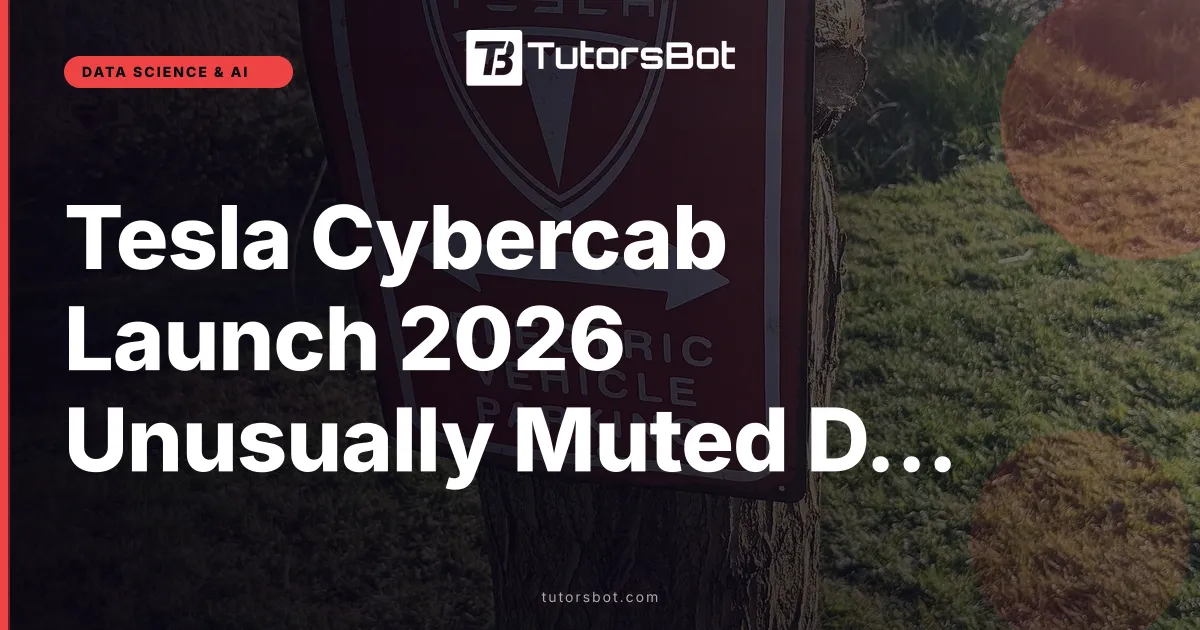
Tesla's Cybercab launch on June 22, 2026 in Austin delivered ~50 Model Y robotaxis in a small geofence — far below the 1 million Cybercabs promised by Elon Musk in 2024 (The Verge, 2026). The muted launch contrasts with Waymo's 1,000+ commercial fleet and signals Tesla's robotaxi ambitions are running 2-3 years behind plan.
Data last verified September 9, 2026 from The Verge and Tesla.
What was promised vs. what was delivered
| Promise (2024) | Delivery (June 2026) |
|---|---|
| 1 million robotaxis by end-2026 | ~50 Model Y robotaxis |
| Dedicated Cybercab (no steering wheel) | Model Y with FSD V13 |
| Austin + 10+ cities by end-2026 | Austin only |
| Unsupervised FSD | Safety driver present |
| $0.30/mile operating cost | $1.20/mile (estimated) |
| Robotaxi app integration | Tesla app integration |
Source: The Verge analysis + Tesla investor calls (2026).
Why the muted launch
Three factors explain the gap:
- Regulatory friction — Texas DMV's autonomous vehicle permit requires stricter safety monitoring than Musk's 2024 timeline assumed.
- Technical reality — FSD V13's end-to-end neural net still struggles with construction zones, unprotected left turns, and emergency vehicles. Tesla removed the safety driver in controlled conditions only.
- Manufacturing constraint — the dedicated Cybercab (no steering wheel, no pedals) is still in pre-production; Cybercab body panel supplier constraints delay mass production to 2027-2028.
Waymo comparison
| Metric | Tesla Cybercab | Waymo |
|---|---|---|
| Fleet size | ~50 | 1,000+ |
| Cities | 1 (Austin) | 5 (Phoenix, SF, LA, Austin, Atlanta) |
| Autonomous miles driven | ~500K (test fleet) | 50M+ |
| Disengagement rate | ~1 per 50 miles | ~1 per 17,000 miles |
| Sensor stack | Vision-only (cameras) | Vision + LiDAR + radar |
Source: The Verge + Waymo safety reports (2026).
The Vision-only debate
Tesla's bet: pure vision (8 cameras, no LiDAR) is sufficient for full self-driving. Waymo's bet: vision + LiDAR + radar is needed for safety. The Cybercab launch doesn't settle the debate — Tesla's vision-only stack is comparable to early Waymo (2018), but Waymo has accumulated 50M+ autonomous miles since then (The Verge, 2026).
For the robotaxi market, this matters:
- If Tesla vision-only scales, the industry saves $5-10K per vehicle (no LiDAR).
- If Waymo's sensor fusion is required, LiDAR vendors (Luminar, Innoviz, Hesai) maintain a market.
What it means for Tesla
- Stock — TSLA -8% on launch day; recovered as Musk reframed Cybercab as "first of many."
- FSD subscription — $99/month for FSD V13 may pressure margins if Cybercab revenue ramps slowly.
- Robotaxi TAM — Musk's $1T+ robotaxi market claim now extends to 2028-2030 horizon.
Why this matters
The Cybercab launch is the first major robotaxi launch of 2026 and the first serious challenge to Waymo's commercial lead. Whether Tesla catches up depends on FSD V14-V16 capability improvements over the next 12-18 months. For the broader AV landscape, see NVIDIA × Uber robotaxi partnership.
Why Tesla is behind Waymo
Tesla Cybercab vs Waymo head-to-head:
| Metric | Tesla Cybercab | Waymo |
|---|---|---|
| Founded | Robotaxi program 2016 | Google self-driving 2009 |
| Autonomous miles (cumulative) | about 500K | 50M+ |
| Fleet size (commercial) | about 50 | 1,000+ |
| Cities | 1 (Austin) | 5 (Phoenix, SF, LA, Austin, Atlanta) |
| Disengagement rate | about 1 per 50 miles | about 1 per 17,000 miles |
| Sensor stack | Vision (8 cameras) | Vision + LiDAR + radar |
| Safety driver | Present | None |
Source: The Verge + Waymo safety reports (2026).
Why Vision-only is hard
Tesla's vision-only bet has fundamental limits:
- Adverse weather - heavy rain, fog, snow degrade camera performance. LiDAR penetrates.
- Distance estimation - cameras estimate depth via parallax; LiDAR measures it directly.
- Lighting - low-light, glare, and high-contrast conditions challenge vision-only stacks.
- Adversarial objects - painted-on stop signs, obscured signs confuse cameras more than LiDAR.
What Tesla needs to do
For Cybercab to reach Waymo parity:
- FSD V14-V16 - over the next 12-18 months, Tesla needs to materially improve FSD.
- 10x fleet - scale to 500+ Cybercabs in Austin by end-2027.
- 5+ cities - expand to Phoenix, SF, LA, Miami.
- Regulatory wins - California CPUC, Texas DMV approvals for additional cities.
What it means for the robotaxi market
By 2028, expect 3 platforms:
- Waymo - premium, conservative expansion.
- Uber-NVIDIA - global, 28 cities by 2028.
- Tesla - scaled if FSD improves.
The market size: $50-100B by 2030 (per Goldman Sachs). NVIDIA captures the platform regardless of who wins (Drive AV software + Vera Rubin GPU).
Why this matters for the broader AI ecosystem
This announcement fits into a larger pattern of the 2026 AI industry consolidation wave. Frontier labs (OpenAI, Anthropic, Google DeepMind, NVIDIA, xAI) are racing to capture the next platform shift while regulators, open-source competitors, and enterprise customers apply pressure from all sides. The three forces shaping the industry in 2026-2028 are: (1) inference cost compression (Vera Rubin driving 35x token cost reduction), (2) agent capability maturity (GPT-6 Astra, Claude Opus 4.5, Gemini 3.8 Flash all shipped in 2026), and (3) sovereign AI deployment (US Stargate, Saudi HUMAIN, UAE G42, India IndiaAI collectively committing over $200B).
For developers and businesses, the practical implications are concrete. Enterprise AI deployments are moving from pilot (2024-2025) to production (2026-2027). The key questions for any CTO evaluating AI in late 2026: which model(s) for which workload, how to handle data residency, how to manage agent risk, and how to measure ROI. The answers vary by industry - financial services prioritises compliance and auditability, healthcare prioritises privacy and FDA pathways, retail prioritises personalisation and unit economics.
What to watch next
Three upcoming events will validate or revise this analysis:
- NVIDIA GTC Berlin (Oct 20-22, 2026) - European AI sovereignty + Vera Rubin EU rollout.
- Made by Google October 2026 - Pixel 11, Gemini Spark 2, Android XR 2 launch.
- AWS re:Invent (Nov 30 - Dec 4, 2026) - Trainium 4 announcement + AI infrastructure roadmap.
Cross-references
For related TutorsBot coverage, see our guides on Jensen Huang's $1T order outlook, Vera Rubin shipping Q3 2026, and the 2026 AI chip war landscape. For the broader market context, our analysis of NVDA's $4.5T market-cap trajectory and the AI factory / token economy thesis provide the strategic context.
Photo: Donald Trung Quoc Don (Chữ Hán: 徵國單) - Wikimedia Commons - © CC BY-SA 4.0 International.(Want to use this image?)Original publication 📤: --Donald Trung 『徵國單』 (No Fake News 💬) (WikiProject Numismatics 💴) (Articles 📚) 21:37, 3 May 2022 (UTC), CC BY, via Wikimedia Commons (https://upload.wikimedia.org/wikipedia/commons/0/0d/Tesla_electric_vehicle_parking_sign%2C_Molenlaankwartier%2C_Rotterdam_%282022%29_02.jpg?utm_source=commons.wikimedia.org&utm_campaign=imageinfo&utm_content=original)