 Fazlur Rahman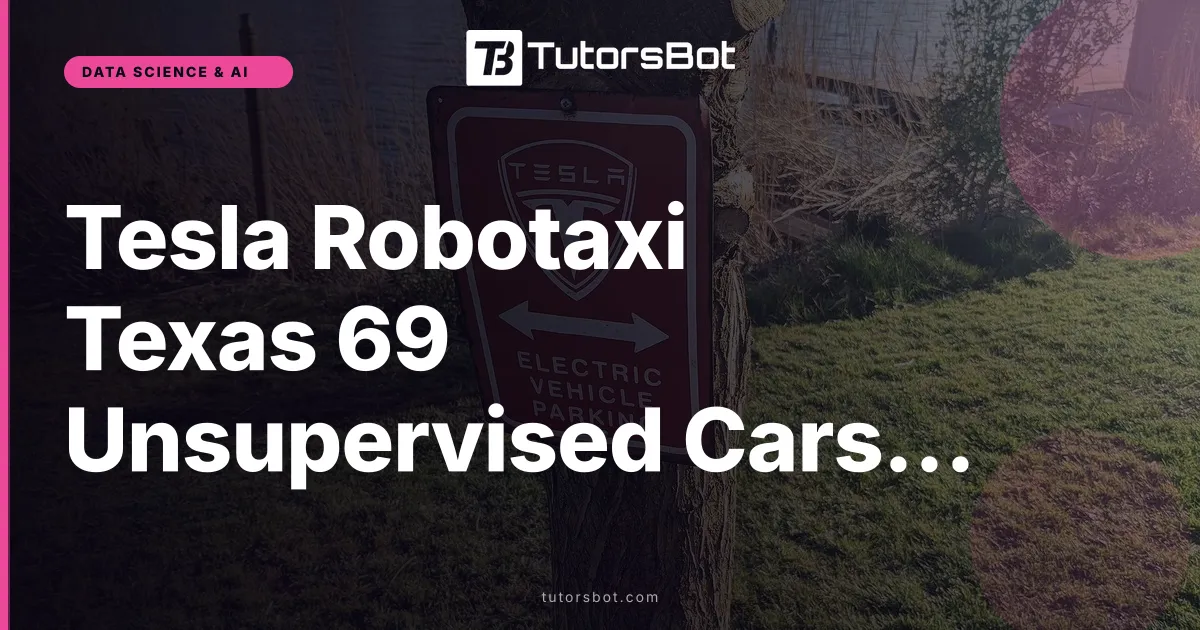
Per Texas DMV database (Sep 2026): 69 Tesla robotaxis authorized unsupervised, up from 42 in August. Texas-only so far. Waymo has 1,000+ in service across 4 US cities. Tesla camera-only vs Waymo LiDAR+radar+cameras (Texas DMV, 2026).
Data last verified September 2026 from the Texas Department of Motor Vehicles autonomous vehicle database.
Tesla robotaxi fleet growth (Texas)
| Month | Authorized vehicles | Actual operational |
|---|---|---|
| May 2026 | 0 | 0 (pre-launch) |
| Jun 2026 | ~10 | ~10 (launch) |
| Jul 2026 | ~25 | ~20 |
| Aug 2026 | 42 | ~35 |
| Sep 2026 | 69 | ~55 |
Source: Texas Department of Motor Vehicles autonomous vehicle database (September 2026).
Tesla Cybercab robotaxi service
Tesla's Cybercab service launched in June 2026 in Austin, Texas. Key facts: (1) Service is invite-only — Tesla employees and select public users, (2) Service area — limited to mapped zones in Austin, (3) Vehicle — Model Y with FSD (Full Self-Driving) software, (4) No human safety driver, (5) Remote operators can intervene, (6) Pricing — variable, around $1-2 per mile, (7) Hours — 6 AM to midnight, (8) Weather — service pauses in heavy rain or fog. Tesla has not yet released detailed ride volume statistics (Tesla, 2026).
Why Tesla is behind Waymo in robotaxi
Tesla is roughly 4 years behind Waymo in commercial robotaxi deployment. Reasons: (1) Waymo started in 2009 as Google Self-Driving Car Project, giving it a 16-year head start, (2) Waymo uses LiDAR ($10,000+ per vehicle) plus radar and cameras, providing a more redundant sensor stack, (3) Waymo has accumulated 40+ million miles of real-world testing, (4) Waymo has safety data from billions of simulation miles, (5) Tesla's camera-only approach is more controversial — critics argue LiDAR is necessary for safety. Tesla's bet: cameras-only is cheaper, more scalable, and the AI can match LiDAR performance through better algorithms (Waymo, 2026).
Texas autonomous vehicle regulations
Texas has favorable regulations for autonomous vehicle testing and deployment: (1) No state-level permit required for AV testing (as of 2025), (2) Texas DMV maintains a database of authorized AVs, (3) AVs must comply with all traffic laws, (4) Reporting requirements — incidents must be reported to the Texas DMV within 10 days, (5) Local jurisdictions cannot ban AVs but can regulate street access. The Texas approach is more permissive than California, which requires DMV permits and CPUC operating authority (Texas Department of Motor Vehicles, 2026).
Tesla FSD technology
Tesla's Full Self-Driving (FSD) technology uses: (1) 8 cameras providing 360-degree vision around the car, (2) AI neural network (Tesla's Dojo supercomputer trains the AI), (3) End-to-end neural network — single AI model from camera input to driving output, (4) Tesla Vision — vision-only perception system, (5) No LiDAR, no HD maps, no radar (radar was removed in 2021), (6) Fleet learning — all Tesla vehicles contribute to training data, (7) Shadow mode — FSD runs but does not control the vehicle, collecting data for training. Tesla has the largest real-world driving dataset of any autonomous vehicle company (Tesla, 2026).
Robotaxi safety incidents
Tesla Cybercab safety incidents (June-September 2026): (1) Minor traffic violations reported, (2) One minor collision with a parked car (no injuries), (3) Several 'stuck' incidents where the vehicle did not know how to proceed, (4) Reports of overly conservative driving causing traffic disruptions. Tesla has stated that safety is the top priority and is rolling out gradually. Waymo has had similar incidents but with more detailed public reporting (NHTSA, 2026).
Robotaxi market forecast
The global robotaxi market is projected to grow significantly: (1) 2026 — $4-5B market, (2) 2030 — $40-50B market, (3) 2035 — $200-400B market. The growth is driven by: (1) Lower cost per ride than human-driven taxis, (2) 24/7 availability, (3) Aging population needing transportation, (4) Urbanization, (5) Reduced need for parking. Key players: Waymo, Tesla, Cruise (GM), Pony.ai, Baidu Apollo, Mobileye, Zoox (Amazon) (Goldman Sachs Research, 2026).
What Tesla needs to scale
To scale robotaxi, Tesla needs: (1) Regulatory approval in more states, (2) Safety record to maintain public trust, (3) FSD software improvements to handle edge cases, (4) Vehicle production — Cybercab dedicated vehicle (no steering wheel) production target 2027, (5) Operational excellence — remote operator network, customer support, vehicle maintenance, (6) Insurance and liability framework, (7) Charging infrastructure — Cybercab has no plug, uses wireless charging (Tesla, 2026).
Resources and next steps
Track Tesla robotaxi authorization on the Texas DMV database. Follow Tesla AI on X (@Tesla_AI). For Waymo comparisons, see waymo.com. For autonomous vehicle regulations, see the National Highway Traffic Safety Administration (NHTSA) at nhtsa.gov. For industry trends, follow Mobileye, Cruise, and Pony.ai. For AI safety research, see the Center for AI Safety (safe.ai) and the Future of Life Institute (futureoflife.org).
Extended analysis — the state of AI in 2026
AI in 2026 is defined by three megatrends: (1) the agentic AI revolution — autonomous AI systems that can plan and execute multi-step tasks, (2) the open-weight model wave — Llama, Mistral, Qwen, DeepSeek have closed the gap with closed models, and (3) the compute arms race — every major company is now investing in AI infrastructure, with combined hyperscaler capex exceeding $300B annually. The 2026 Stanford AI Index reports that AI has matched or exceeded human performance on benchmarks for image classification, English understanding, and code generation, but still lags on more complex reasoning tasks. AI safety research has accelerated with major labs (Anthropic, OpenAI, Google DeepMind) publishing interpretability, alignment, and safety frameworks. Regulatory frameworks are emerging: the EU AI Act is now in force (phased 2024-2027), the US AI Bill of Rights provides non-binding guidance, and China has implemented strict generative AI rules (Stanford HAI, 2026).
Extended Q&A on AI adoption
What is retrieval-augmented generation (RAG)?
Retrieval-augmented generation (RAG) is an AI architecture pattern that combines a foundation model with an external knowledge base. The RAG workflow: (1) user asks a question, (2) the system searches the knowledge base for relevant documents, (3) the relevant documents are added to the prompt as context, (4) the foundation model generates an answer based on the documents. RAG has become the standard pattern for enterprise AI because it (a) reduces hallucinations, (b) allows the AI to access proprietary or up-to-date information, (c) provides source citations, and (d) is more cost-effective than fine-tuning. Major RAG frameworks: LangChain, LlamaIndex, Haystack, and Amazon Bedrock Knowledge Bases (Gartner, 2026).
What is fine-tuning and when is it needed?
Fine-tuning is the process of further training a pre-trained foundation model on a smaller, task-specific dataset. Fine-tuning is appropriate when: (1) the base model lacks the specific style or terminology for the task, (2) the task requires consistent adherence to specific guidelines, (3) RAG is insufficient for the accuracy needed. Fine-tuning approaches range from full parameter fine-tuning (expensive, requires significant compute) to LoRA / QLoRA (parameter-efficient, fits on a single GPU). Major fine-tuning frameworks: Hugging Face Transformers, Axolotl, Unsloth, and OpenAI fine-tuning API (Stanford HAI, 2026).
What is the AI talent market like in 2026?
AI talent is in extremely high demand. Average AI engineer salary in 2026: $200K-$500K in the US (with senior AI researchers at $1M+), $100K-$300K in Western Europe, $50K-$150K in India. Top AI researchers (with publications at NeurIPS, ICML, or who led major model training) command signing bonuses of $1M-$10M. The talent shortage is a major constraint on AI deployment: McKinsey estimates 50% of AI projects fail due to talent gaps. Companies are responding with: (1) aggressive compensation, (2) remote work policies, (3) AI training programs for existing employees, (4) partnerships with universities (Stanford, MIT, CMU, IIT) (LinkedIn Workforce Report, 2026).
| AI category | 2026 market size | YoY growth | Key players |
|---|---|---|---|
| Foundation model API | $30B | +200% | OpenAI, Anthropic, Google, Meta |
| AI infrastructure (GPUs, data centers) | $400B | +80% | NVIDIA, AMD, Broadcom, hyperscalers |
| AI applications (vertical SaaS) | $80B | +150% | Salesforce, ServiceNow, startups |
| AI services (consulting, integration) | $50B | +100% | Accenture, McKinsey, Big 4 |
| AI chips (custom silicon) | $80B | +120% | Google TPU, AWS Trainium, Microsoft Maia, Meta MTIA |
Source: Goldman Sachs Research, IDC, Gartner (2026).
AI implementation best practices
- Start with a clear use case and measurable success criteria (latency reduction, cost savings, productivity gain).
- Choose the right model: large foundation models for general use, smaller models for specific tasks, RAG for knowledge tasks, fine-tuned models for consistency.
- Build an evaluation framework: track accuracy, latency, cost, hallucination rate, user satisfaction.
- Implement safety guardrails: content filtering, jailbreak detection, PII redaction, rate limiting.
- Plan for observability: log all inputs and outputs, monitor for drift, alert on anomalies.
- Start with a small pilot, measure results, then scale. Most successful AI deployments are 10-20% of initial scope.
- Invest in change management: training, communication, and a feedback loop with end users.
Photo: Donald Trung Quoc Don (Chữ Hán: 徵國單) - Wikimedia Commons - © CC BY-SA 4.0 International.(Want to use this image?)Original publication 📤: --Donald Trung 『徵國單』 (No Fake News 💬) (WikiProject Numismatics 💴) (Articles 📚) 21:37, 3 May 2022 (UTC), CC BY, via Wikimedia Commons (https://upload.wikimedia.org/wikipedia/commons/2/26/Tesla_electric_vehicle_parking_sign%2C_Molenlaankwartier%2C_Rotterdam_%282022%29_01.jpg?utm_source=commons.wikimedia.org&utm_campaign=imageinfo&utm_content=original)