On 24 November 2026, Nature reported on two protein-design campaigns. Anthropic's Claude had produced 354 confirmed binders from 1,320 designs in August. OpenAI's GPT-6.2 produced 35 confirmed binders from 322 designs in November. Here is how Claude vs ChatGPT protein design compares on the same rows.
The results came from different months and different labs. This comparison lines them up row by row. It shows where general chatbots still trail specialist protein tools. For the wider field, see our ChatGPT vs Claude vs Gemini comparison.
What happened in the two labs
Anthropic reported on 18 August 2026 that Claude Mythos Preview and Opus 4.8 orchestrated specialist design models inside Claude Science. The Anthropic research post covers the 48-hour run.
OpenAI announced on 24 November 2026 that its latest models had designed new proteins. Some worked when made and tested. The OpenAI announcement covers five targets for a pre-release GPT-6.2. Each design was a minibinder, a small protein that sticks to one target.
Nature recorded the caution around both results. Martin Pacesa of the University of Zurich, said that in most cases a specialist beats a generalist on a given task. OpenAI's Joy Jiao stressed that the work is a proof of principle. Specialist tools were still needed for key steps.
Claude vs ChatGPT protein design in the wet lab
The Adaptyv Bio case study describes a blinded test of both labs' designs. The lab received designs without knowing which model produced them. It expressed them and measured binding.
| Metric | Claude, August 2026 | GPT-6, November 2026 | Source |
|---|---|---|---|
| Designs tested | 1,320 across 16 targets | 322 across 5 targets | Anthropic, Adaptyv |
| Confirmed binders | 354 | 35 | Anthropic, Adaptyv |
| Overall hit rate | 26.8% | 10.9% | Adaptyv, OpenAI |
| Targets solved | 14 of 15 evaluable | 5, with IL-17A 18, VEGF-A 8, PD-L1 5, IL-7Ra 3, TrkA 1 | Adaptyv, OpenAI |
| Wall-clock time | 48 hours for 16 targets | Not stated | Anthropic |
| Compute | Up to 12,500 NVIDIA H100 hours | Not stated | Anthropic |
| Who validated | Adaptyv Bio blind lab, Twist Bioscience | Specialist models supplied and filtered candidates | Adaptyv, OpenAI |
Anthropic needed 3.7 designs per confirmed binder, since 1,320 designs produced 354 hits. OpenAI needed 9.2, since 322 designs produced 35 hits. That is about 2.5 times as many designs per success. The targets, selection steps and labs differ, so read it as a rough gauge, not a head-to-head result.
Claude would have won 5 of 6 competition challenges. The TREM2 target hit 80% against 38.3% in the competition. Adaptyv says an end-to-end campaign could run in weeks for a couple of thousand dollars. That covers tokens, compute and wet-lab credits. Checked November 2026 on the Adaptyv Bio case study.
Which tool fits which protein task
The Claude vs ChatGPT protein design split below follows from published numbers, not one shared test. Claude has no published antibody figures.
- Sequence prediction and multi-target campaigns - the newest Claude models, which led the sequence test
- Antibody design - only OpenAI has published results, at 70% and 66% binding for its GPT-6 family
- Full 3D structure prediction - specialist tools such as ESMFold2, Boltz-2 or OpenFold3
- Raw instrument files - Claude Opus 5, which reproduced a contract lab's purity figures
Claude Fable 5 was blocked on 44% of questions, and Claude Sonnet 4.5 refused 97% of prefilled protein requests. Anthropic keeps these capabilities out of general access in Claude Fable 5. Its September 2026 threat report on biosecurity gives the wider picture.
Where general models still lose to specialist tools
OpenAI says specialist models such as SolubleMPNN and ProteinMPNN supplied sequences. Others, including ESMFold2, Boltz-2 and OpenDDE, filtered candidates before lab testing. TM-score measures how close a predicted shape is to the true shape, where 1 is a perfect match.
| Task | General models | Specialist tools | Source |
|---|---|---|---|
| Full structure prediction, mean TM-score | GPT-6.2 0.26, internal model 0.38 | ESMFold2 0.93 | OpenAI announcement |
| Next-amino-acid prediction, gap over shuffled control | Claude Fable 5.2 +45.1, Claude Opus 5.5 +27.4, GPT-6.2 Sol +2.4 | ProGen3-3B +32.5, ProtGPT3-10B +27.7 | Tu and Chen benchmark |
| Antibody redesign | VHH antibodies, a single-domain format, to IL-4Ra: 128 of 182 bound | None published | OpenAI announcement |
OpenAI also says the results "do not yet establish that our models can generate de novo minibinders end-to-end". De novo means built without a starting template.
Is this real understanding or memorized training data?
Nature reports that Xinming Tu of the AI-biology company Phylo prompted models from OpenAI, Anthropic and Google. They predicted the sequences of obscure bacterial proteins. Tu and Leo Chen of Harvard Medical School published the results on 16 November 2026. Nature says their blog post on protein sequences "set off a frenzy among computational biologists".
Their test used 668 bacterial or archaeal proteins from 167 Pfam families of unknown function. Each protein was cut at five random positions, giving 3,340 cuts. A shuffled control repeated the task on scrambled sequences with the same amino-acid mix, so only order-sensitive skill counted. Twenty-two models took part, at a total API cost of about $730.
Claude Fable 5.2 led with a gap of +45.1 points, about 54% correct on real sequences against 9% shuffled. Claude Opus 5.5 scored +27.4. The specialist ProGen3-3B reached +32.5 and ProtGPT3-10B +27.7.
On 56 proteins first made public between August 2 and 27, 2026, every model scored roughly half its main-set result. Those proteins appeared after the assumed 1 July 2026 training cutoff. Nature says some researchers think such abilities could be regurgitated training data. Tu's post argues the models were instead trained on protein sequences at scale.
Claude protein design
Anthropic reported that Claude Opus 5 received only a contract lab's raw files and a two-sentence prompt. It finished one nuclear magnetic resonance set in 23 minutes. It finished one liquid chromatography with mass spectrometry set in 19 minutes. The NMR set identifies molecules from the magnetic signal of their nuclei. The LC-MS set separates a mixture and measures the mass of each part. It reported 96.4% purity against the laboratory's 96.33%.
Anthropic announced Claude Science on 30 June 2026 as an AI workbench for scientists. It ships more than 60 preconfigured skills and connectors across genomics, proteomics and structural biology. No subscription prices or usage caps are published. Our Claude data science tools and AI workflows guide covers the wider toolset.
AlphaFold 3 protein structure prediction
AlphaFold2 won CASP14 on 30 November 2020. Its median error was under 1 Angstrom, about three times better than the next best system. AlphaFold3 and AlphaFold Server launched on 8 May 2024. Its creators shared the 2024 Nobel Prize in Chemistry. The live database now lists over 260 million structure predictions.
Where to check the latest figure
The Claude vs ChatGPT protein design gap reflects two separate campaigns, not a head-to-head trial. Check the OpenAI announcement for per-target hits. The Adaptyv case study has the blinded binding results.
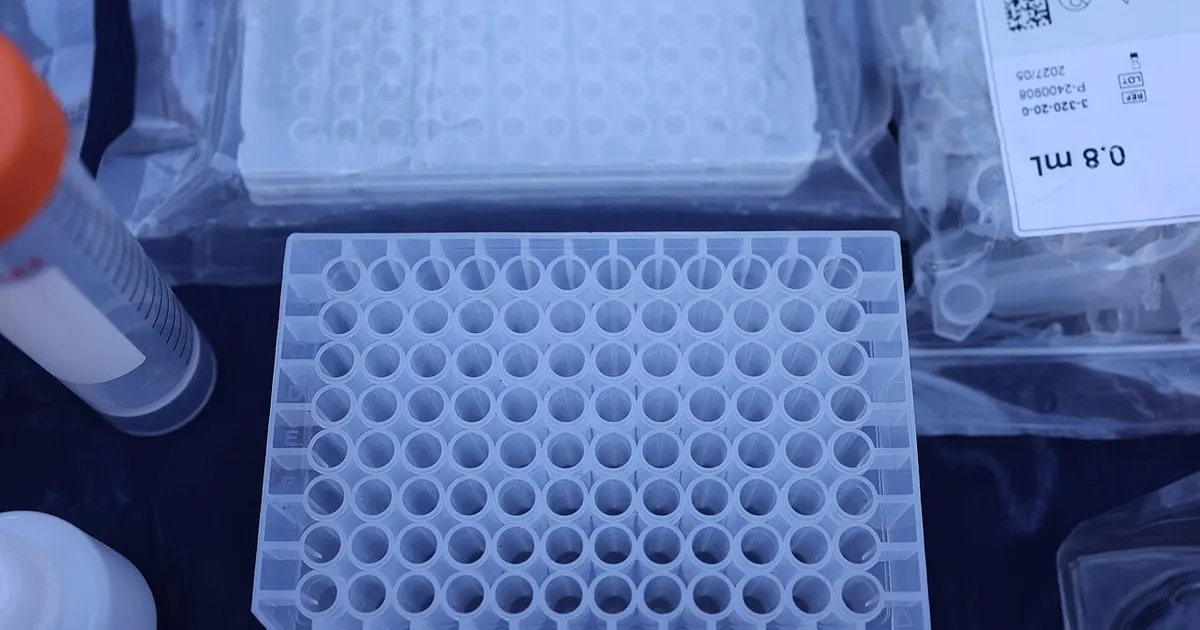
Photo: Gannu03, CC BY-SA 4.0, via Wikimedia Commons (https://commons.wikimedia.org/wiki/File:96-well_microplate.jpg)