 Fazlur Rahman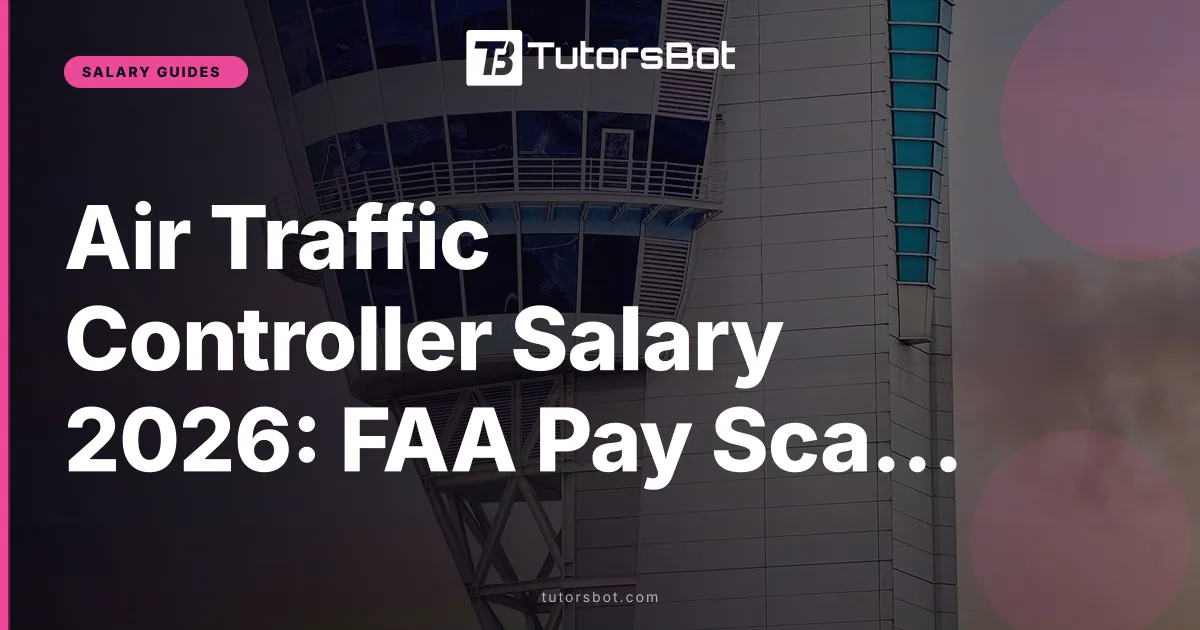
The air traffic controller career is one of the highest-paying federal jobs that does not require a four-year degree, and the 2026 job market is the tightest it has been since the controller shortage began in 2014. The FAA is short roughly 1,500 controllers, which has the practical effect of pushing overtime up, training slots open, and starting pay higher than the published GS schedule would suggest. But the job is not for everyone. The washout rate at the FAA Academy approaches 50% in some cohorts, the shifts are brutal, and mandatory retirement at age 56 means the career is shorter than most federal jobs. This guide walks through the pay, the qualification path, and the day-to-day reality so you can decide whether the trade-offs are right for you.
Compensation data cited is drawn from the 2025 and 2026 OPM General Schedule pay tables with locality adjustments applied, the FAA annual controller workforce report, and the BLS Occupational Employment Statistics for air traffic controllers. Figures reflect base pay plus average overtime and premium pay. Verify with current USAJOBS postings and the FAA hiring announcement, because pay tables are updated annually and locality pay rates are revised quarterly.
Air Traffic Controller Pay at a Glance
The table below summarizes the 2026 compensation landscape for FAA air traffic controllers. The pay scale is the General Schedule (GS) with locality adjustments, and the entry, full-performance, and journeyman stages correspond to the FAA's three career milestones.
| Career stage | GS level | Low (rural) | Median | High (hub) | Notes |
|---|---|---|---|---|---|
| Academy student | — | $22,000 | $25,000 | $28,000 | Paid training, not a salary |
| Entry-level (developmental) | GS-7 to GS-9 | $48,000 | $58,000 | $72,000 | First 1-2 years on the floor |
| Full-performance (certified) | GS-10 to GS-12 | $78,000 | $108,000 | $132,000 | After facility certification |
| Journeyman (5+ years certified) | GS-12 to GS-13 | $108,000 | $135,000 | $160,000 | Includes most controllers |
| Facility-level / supervisory | GS-13 to GS-14 | $128,000 | $155,000 | $185,000 | Operations manager, area manager |
| Total comp with overtime (hub) | — | $115,000 | $155,000 | $210,000 | Includes OT, premium, locality |
How the FAA Pay Scale Works for Controllers
Air traffic controllers are paid on the General Schedule (GS) with locality pay, the same pay system used for most federal white-collar employees. The GS runs from GS-1 to GS-15, and controllers typically enter at GS-7 and progress to GS-12 or GS-13 over a career. Locality pay adjusts the GS base for the cost of labor in the metro area, and locality rates range from 16% in rural areas to 41% in the San Francisco and New York metros. The 2026 GS-12 base is $67,963, and the GS-12 in the highest-locality metro is $95,737, which is the most a full-performance controller makes before overtime.
The federal pay system is unusual for private-sector candidates because it is fully transparent: every controller in the country at the same GS level and locality makes the same base. There is no salary negotiation on base pay. What is negotiable is overtime, premium pay, and the assignment to a high-paying facility. The controllers who clear $180,000 to $210,000 in total compensation are the ones at hub facilities with high overtime hours, not the ones with high base pay.
What Drives Controller Pay in 2026
Four variables explain almost all of the variation in controller pay: GS level, facility assignment, locality, and overtime. The combination of facility and overtime is the variable that pushes a controller from the $90,000 median to the $185,000 high end, not the GS level alone.
1. GS level
Every controller starts at GS-7 and progresses to GS-12 (full performance) within 2 to 4 years of facility certification. From there, the next step is GS-13, which is the journeyman level for most controllers and the upper bound for a non-supervisory career. GS-14 and GS-15 are supervisory roles (operations manager, area manager, district manager) and represent the ceiling for a non-executive FAA career. The GS-13 jump from GS-12 takes an average of 5 to 7 years, and many controllers stay at GS-12 for their entire career because the jump is competitive and not guaranteed.
2. Facility assignment
The facility is the single biggest determinant of total compensation after GS level, because the busiest facilities pay the most overtime and have the highest locality. The 30 Level 12 hub towers and the 21 TRACONs that cover the busiest airspace in the country are the highest-paying assignments, and competition for them is fierce. The 148 Level 4 to 7 rural towers pay less, and a controller assigned to a small rural tower can earn 30% to 40% less than a controller at a hub at the same GS level. New-hire assignments are based on the Academy class ranking, and the controllers at the top of the class can pick their facility, which means the top of every Academy class goes to the hubs and the bottom goes to the rural towers.
3. Locality pay
Locality pay adjusts the GS base for the cost of labor in the metro area, and the 2026 locality rates range from 16% in rural areas to 41% in the San Francisco and New York metros. Locality is automatic and is not negotiated. A GS-12 controller in the San Francisco locality earns $95,737 in base pay, and a GS-12 controller in a rural locality earns $78,856, for a $17,000 spread before overtime. The locality rates are revised annually and are based on the Bureau of Labor Statistics wage surveys for the metro area.
4. Overtime and premium pay
Overtime is where the largest paychecks are made. The FAA pays overtime at 1.5x the base rate for any hours over 40 per week, and the 2026 overtime budget is at record highs because the controller shortage is forcing the FAA to staff facilities with overtime rather than new hires. A full-performance controller at a hub facility who works 10 hours of overtime a week adds $35,000 to $45,000 to the annual pay, which is more than the gap between GS-12 and GS-13. Premium pay (Sunday premium, night differential, holiday premium) adds another $5,000 to $15,000. For a hub controller who routinely works overtime, total compensation of $180,000 to $210,000 is realistic by year 7 to 10.
Controller Salary by Facility
The highest-paying facilities as of 2026 are the New York TRACON (N90), the Atlanta TRACON (A80), the Southern California TRACON (SCT), the Chicago TRACON (C90), and the Potomac TRACON (PCT). These five TRACONs cover the busiest airspace in the country and the FAA staffs them with the most experienced controllers, which drives the locality pay and the overtime to the top of the scale. Among towers, the highest-paying are JFK, LAX, ATL, ORD, and DFW. The lowest-paying facilities are the Level 4 to 7 rural towers in Wyoming, Montana, and the Dakotas, where the cost of living is low and overtime is rare.
TRACON vs tower
A TRACON (Terminal Radar Approach Control) handles the airspace within 40 to 60 miles of an airport, and TRACON controllers earn 10% to 20% more than tower controllers at the same GS level because the workload is higher, the airspace is more complex, and the overtime is more plentiful. A tower controller works the local airspace within 5 miles of the airport, and the work is mostly visual sequencing of arrivals and departures. The TRACON is the higher-paying path, but it is also the higher-stress path, and the washout rate during on-the-job training is higher at TRACONs than at towers.
En route centers
The 21 en route centers (ARTCCs) handle the high-altitude airspace between airports, and they pay a locality rate that is typically below the major TRACONs but above the rural towers. En route controllers earn $115,000 to $155,000 at full performance with average overtime, and the workload is steady rather than peaky, which is a meaningful quality-of-life difference. The en route path is the best choice for controllers who want high pay without the sprint-and-recover rhythm of a TRACON or a hub tower.
The Hidden Comp: Benefits, Pension, and Retirement
The base pay is only part of the compensation picture. The full package includes the federal pension (FERS), the TSP (Thrift Savings Plan) match, the health insurance, and the early-retirement provision. A controller who retires at age 50 with 25 years of service gets roughly 50% of their high-3 average pay for life, which is a meaningful pension by any standard. The TSP match is 5% of salary, and the federal health insurance (FEHB) is the most generous health benefit in the US. Add the 26 days of paid leave, the 13 sick days, and the federal holidays, and the total compensation package is meaningfully higher than the base pay alone would suggest.
How to Decide Whether ATC Is Right for You
The right candidate for ATC is a person who is good at spatial reasoning (the AT-SA test is the strongest predictor of Academy success), can handle high-stakes decision-making under time pressure, is comfortable with shift work, and is willing to relocate to wherever the FAA assigns a facility. The washout rate at the Academy is the strongest filter — about 50% of candidates in some cohorts do not complete the program, and another 15% to 25% do not certify at their first facility — so the financial and emotional cost of a failed attempt is real. The right candidate is also someone who can think 5 to 10 years out, because the pension math only works if you stay past 20 years of service, and the GS-12 to GS-13 jump only works if you stay past 7 years at full performance. The compensation is excellent for the right person, but the career is shorter and the lifestyle is harder than the federal norm, and the right person is one who is comfortable with both.
Bottom Line
Air traffic controller salary in 2026 runs $90,000 to $185,000, with the median at $132,000. The highest-paying paths are GS-13 journeyman controllers at the major TRACONs and hub towers, with total compensation clearing $180,000 to $210,000 once overtime is factored in. The qualification path is a 3-step pipeline (USAJOBS → AT-SA → FAA Academy) followed by 1 to 3 years of on-the-job training, and roughly 50% of candidates do not complete the program. The compensation is excellent, the retirement is uniquely generous, and the lifestyle is harder than the federal norm. Verify with the current USAJOBS posting and the FAA hiring announcement before you apply, because the washout rate is real and the time cost of a failed attempt is the most important number on the page.
Photo: Harrison Keely, CC BY, via Wikimedia Commons (https://upload.wikimedia.org/wikipedia/commons/a/a0/The_FAA_air_traffic_control_tower_at_Philadelphia_International_Airport.jpg?utm_source=commons.wikimedia.org&utm_campaign=imageinfo&utm_content=original)