Fazlur Rahman
One Bag Beats the Carousel
Ask anyone who has waited forty minutes at a carousel whether the best backpacks for backpacking travel are worth the research, and you will get a short answer. One bag changes the geometry of a trip: you deplane and walk past the baggage claim, regional connections stop being a roulette of transfer fees, and the difference between a 40L pack and a checked roller compounds across every leg of an itinerary. In 2026 the travel-backpack market has matured to the point where the real question is not whether a carry-on backpack can replace a roller — it can — but which trip shape your bag should be built around. The math also favors the backpack over time: a $185 pack used on twelve trips a year costs less per boarding than a single checked-bag round trip on many carriers, and it never waits at a carousel.
That is why this guide is organized by scenario rather than by spreadsheet. A weekend city hop and a two-week one-bag run punish completely different design choices, and a creator carrying cameras has a third set of needs entirely. Six bags, six trips, one comparison table, and a closing argument on the load-lifter question every first-time buyer gets wrong: clamshell versus top-loader.
The 40L Rule and How We Chose
The carry-on arithmetic first, because it constrains everything else. US majors converge on a 22 x 14 x 9-inch sizer including straps in their strictest moods, and the sweet spot for compliant travel packs is 40–45 liters in a 21–22-inch frame — big enough for two weeks with a packing system, small enough to board. Selection then ran on four axes: how the harness transfers load (a suitcase strap on a backpack disqualifies it instantly on a 20-minute walk), access style and whether the main compartment opens flat, laptop protection, and how honestly the capacity is used. Measurements were checked against maker specifications, and carry verdicts leaned on verified owner reports from real itineraries rather than launch-week impressions. Two compliance notes apply across the board: strict international carriers judge depth before height, and a pack whose external pockets bulge when full can fail a sizer it would pass empty — pack the front pockets for the gate, not the walk to it. Pricing cited was live at the time of publication — click through to confirm current pricing.
| Backpack | Capacity | Access | Standout | Our rating | Check price |
|---|---|---|---|---|---|
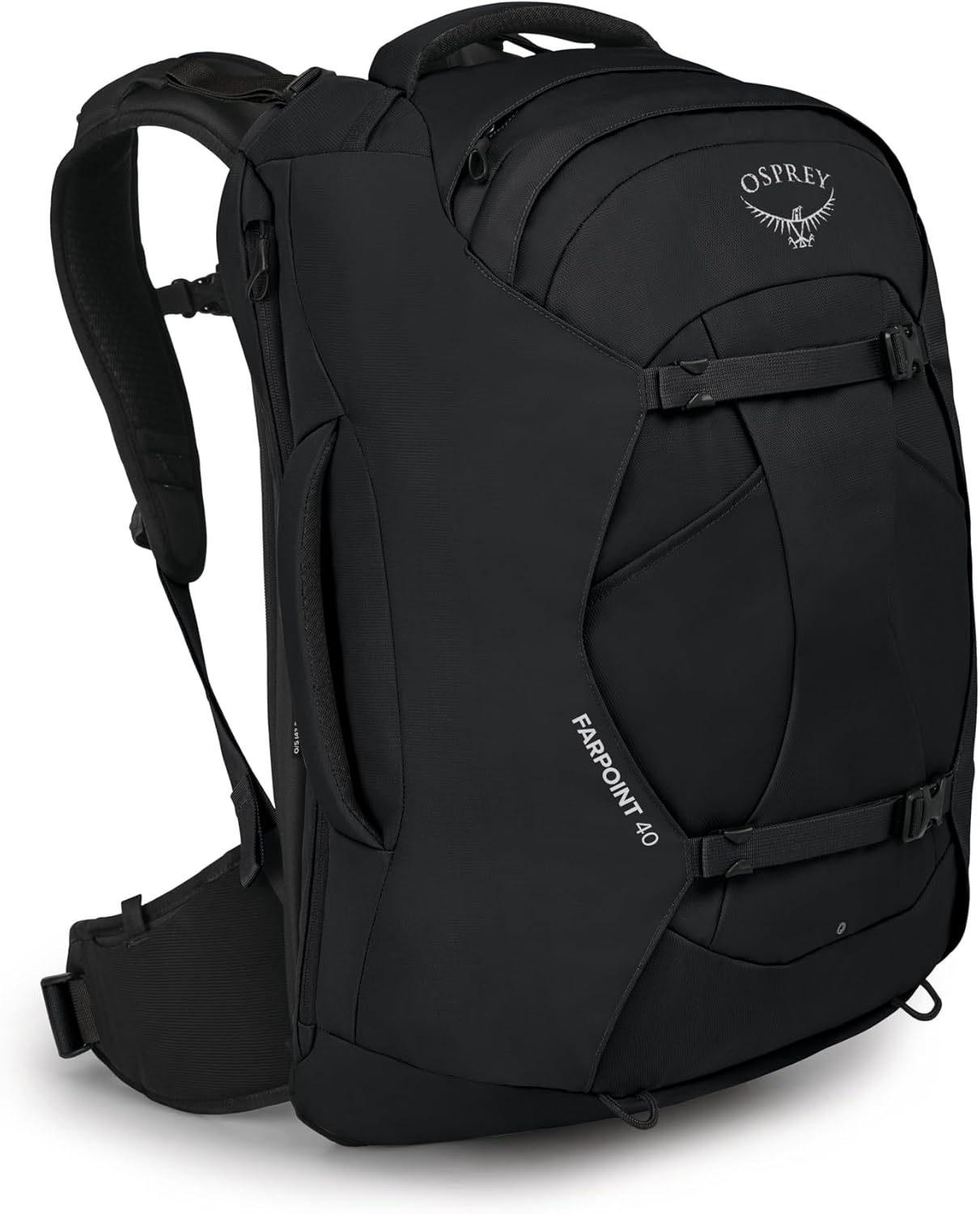
| Osprey Farpoint 40 | 40L | Panel (clamshell-ish) | Harness + warranty | 9.3/10 | Check price |
| Peak Design Travel 45L | 35–45L | Full clamshell | Organization + build | 9.1/10 | Check price |
| YETI Crossroads | ~35L class | Panel + top | Everyday durability | 8.7/10 | Check price |
| Nomatic Travel Pack | 20–30L | Panel | Pocket density | 8.5/10 | Check price |
| Kelty Redwing 44 | 44L | Top + panel | Price-to-durability | 8.4/10 | Check price |
The Weekend Escape: YETI Crossroads
A two-to-three-night city trip has different physics: you need less capacity and more everyday usefulness, because the bag that flies out Friday often becomes your day bag through Sunday. The YETI Crossroads is built on the ultra-durable Berkhloud nylon that made the brand's coolers a flex, with a suspended, well-protected laptop sleeve and a main opening wide enough to pack flat. It is the personal-item-plus option in this lineup — sized to ride under the seat or slide into an overhead beside a larger checked piece for family travel.

Around $200–$300 depending on size at the time of writing, which is honest for hardware that will outlive several trips a year for a decade. The trade is travel-specific: without a load-lifting harness it is a carry, not a haul — perfect for gates and taxis, wrong for twenty-minute cobbles. The Crossroads line’s color range also reads more office than trail, which matters if the bag’s second life is Monday meetings. Pricing cited was live at the time of publication — click through to confirm current pricing.
Scenario verdict: the best two-to-three-day bag and the best everyday companion once you land.
Two Weeks, One Bag: Osprey Farpoint 40
This is the trip the whole category orbits, and the Farpoint 40 remains its benchmark. The magic is that it carries like a hiking pack and boards like a suitcase: a real frame sheet, load-transfer hipbelt and stowable shoulder straps mean a fully packed 40L walks through a 40-minute terminal connection without the shoulder amnesia cheaper bags cause, while the panel opening lays flat for packing-cube discipline. The lockable zips sit at the right height for security, the 40L volume swallows a two-week rotation of merino and quick-dry clothing, and Osprey's All Mighty lifetime warranty — they repair damage from any source, any era — closes the value argument at around $185 at the time of writing.
The honest limitations: the harness stows under a zip panel for boarding, which adds 30 seconds at security, and the front panel's organization is spartan compared to the Peak Design. For women or shorter torsos, the Farview 40 is the same bag resculpted — same trip, better fit. Owners routinely post decade-old Farpoints still in service — the warranty is not marketing, and it shows up in resale value if you ever upgrade. This is the bag that converts rollers to one-bag, and the one that most one-bag travelers keep.
Scenario verdict: the two-week one-bag default, and the guide's overall champion.
The Creator's Carry: Peak Design Travel Backpack 45L
Camera bags used to be a compromise; the Peak Design 45L mostly ends the argument. The full clamshell opens like a suitcase for clothes while the side and rear panels reach camera cubes without unpacking anything, the weatherproof 400D shell shrugs off a Rome downpour, and the whole system — cubes, camera inserts, compression straps — snaps together with the same magnetic latching as the rest of Peak Design's line. It expands from 35L to 45L for the trip home and collapses for storage, which is a genuine trick no rival here pulls off.
Around $300 at the time of writing prices it against the Farpoint like a luxury, and the carry comfort is a half-step behind at full load — the minimalist straps trade load transfer for slimness, a real cost above 30 pounds. Creators and organization maximalists will not care; everyone else should try it loaded first. The cube ecosystem is the quieter argument: the same MagSafe-style latching works across Peak Design’s packing cubes and camera inserts, so a bag bought for one trip becomes a system for all of them.
Scenario verdict: the best backpack for travel with cameras, cables and a place for everything.
The Organizer's Choice: Nomatic Travel Pack
The Nomatic Travel Pack is engineered for people who hate digging. Magnet-close water bottle pockets, an RFID-safe pocket, a suspendable main compartment that keeps shoes away from clothes, dedicated cable management and a valuables compartment — the pocket density is the highest in the test, and the 20-to-30-liter expansion adapts between commute days and trip days better than any fixed-volume rival. It is the best-organized carry-on-compliant pack for short trips and the strongest hybrid of work bag and travel bag here.
The costs are the look (engineered rather than classic) and capacity: at 30L maximum it is a four-to-six-night bag, not a two-week one. Around $250–$280 at the time of writing, aimed squarely at the traveler whose trips are short, frequent and laptop-shaped. In security lines the pocket map pays off visibly: laptops, liquids and valuables each have a dedicated exit, so the bin dance takes seconds instead of minutes.
Scenario verdict: the best short-trip organizer for work-plus-travel patterns.
The Budget Workhorse: Kelty Redwing 44
The Redwing 44 is what happens when a trail brand builds a travel pack and skips the marketing tax. At around $130–$150 it undercuts every bag above by half or more, yet keeps a genuine frame-and-hipbelt suspension that carries heavier loads more comfortably than the slim-strap travel packs, a 44L top-loader body with a front panel zip for the bottom half, and Kelty's decades of pack-building durability. Students, first-time one-baggers, and anyone who would rather spend the gear budget at the destination should start here.
The honest trade-offs: heavier empty weight than the Osprey, chunkier styling that shouts hiking rather than business, and organization that leans on stuff sacks rather than built-in pockets. None of it affects what the bag does on trip day one hundred. The upgrade path is graceful, too: stuff sacks and packing cubes bolt organization onto a top-loader far more cheaply than buying it built in.
Scenario verdict: the most pack per dollar, and the easiest recommendation for beginners.
Clamshell vs Top-Load: Pick Your Religion
Every purchase above reduces to one design fork. Clamshell and panel loaders — Farpoint, Peak Design, Nomatic — open flat like a suitcase: packing cubes stack, everything stays visible, and airport security repacks are painless. Top-loaders — and the Redwing's hybrid — pack faster, shed water better by geometry, and flex their capacity upward on the return trip, at the cost of excavating for the item at the bottom. One-bag veterans tend to start clamshell and never go back; trail veterans feel the opposite. The honest tiebreaker is your packing personality: if you re-pack daily, go clamshell; if you live out of one cavernous space, top-load. The Redwing quietly bridges both: a top-loader body with a front panel zip over the lower half, so the sleeping bag stays buried while the shoes stay reachable.
Whichever camp wins, the rest of the travel cluster holds the complements: the carry-on roller comparison covers the wheeled alternative, and the travel-stroller guide applies the same sizer discipline to family travel. Mentioned but not ranked here because their availability and pricing swing wildly: Tortuga's Setout line, Cotopaxi's Allpa, and REI's house-brand Ruckpack — all respectable, none currently beating the scenario winners above on value.
Top Picks for This Topic
-
1

-
2

-
3

Frequently Asked Questions
- Is a 40L backpack really carry-on compliant? Yes on US majors — a 40L panel-loader in the 21–22 inch class fits the 22 x 14 x 9 sizer, and domestic carriers do not weigh carry-ons. Watch depth on strict international routes and stuffed external pockets.
- Can you travel two weeks with one 40L bag? Yes — with a three-to-four-day clothing rotation, quick-dry fabrics, one packed pair of shoes and weekly laundry. Compression inside 40L beats capacity inside 60L.
- Osprey Farpoint 40 vs Farview 40 — which fits me? Same bag, different torso geometry. Measure your torso: over roughly 20 inches leans Farpoint, under leans Farview.
The six picks above cover the realistic trip shapes a carry-on backpack serves. Pick by your next trip, not your dream one — the bag that boards is the bag that gets used.
As an Amazon Associate, Tutorsbot earns from qualifying purchases. Disclosure.