 Fazlur Rahman
The Resolution Fork: Where 2026 Gaming Monitors Split
Shopping for the best gaming monitors for PC in 2026 means crossing a fork in the road that did not exist three years ago. One path is the mature 1440p high-refresh market: fast IPS panels at 144–180 Hz that a mid-range GPU can actually feed, at prices that keep dropping. The other is the OLED premium tier — 4K and QD-OLED panels with near-instant response and contrast that LCDs cannot touch, finally available at desk sizes. Both paths are excellent; they are excellent for different machines and different games, and buying on the wrong path is the single most expensive mistake in this category.
This guide tiers the market honestly: one 1440p value king, one 4K OLED flagship, one QD-OLED speed demon, one color-accurate work-play hybrid, and one budget workhorse — each with a clear picture of the GPU it expects, because a monitor is only as good as the frame rate behind it. The comparison table and GPU pairing chart are the backbone; read those first if you are in a hurry.
Read the Specs Like a Pro
Three numbers dominate marketing, and only two of them matter equally. Refresh rate (Hz) is how many times per second the panel can draw a new image — the ceiling on motion smoothness. Response time is how fast one pixel changes to the next; on modern IPS panels the quoted 1ms figures are best-case, and what actually matters is whether the panel smears dark scenes (IPS glow and black smearing remain the LCD weaknesses). OLED changes this conversation entirely: because each pixel switches itself off, response is effectively instantaneous — around 0.03ms — and motion clarity at 240 Hz looks cleaner than an LCD at the same refresh. The third number, contrast ratio, is where OLED simply leaves LCD behind: true blacks make night scenes in games look like night scenes instead of gray fog. HDR on LCDs at these prices is mostly marketing brightness; on OLED it is a genuine upgrade.
The GPU Pairing Table (Read This Before the Reviews)
The honest way to buy a monitor in 2026 is backwards: look at your GPU, then your target games, then the panel. A 4K 240 Hz OLED behind a mid-range card is a beautiful screen running at 90 fps; a 1440p 180 Hz panel behind a flagship is leaving frames on the table. Use this chart as the first filter:

| GPU class | Realistic target at 1440p | Realistic target at 4K | Right monitor tier |
|---|---|---|---|
| Entry / previous-gen mid (RTX 4060 class) | 100–165 fps, esports titles maxed | 60–80 fps with upscaling | 1440p high-refresh (UltraGear, M27Q) |
| Upper mid (RTX 4070 Ti / 5070 class) | 144–180+ fps most titles | 90–140 fps with upscaling | 1440p 240Hz or QD-OLED 360Hz |
| High-end (RTX 4080 / 5080 class) | 180+ fps, max settings | 120–160 fps with upscaling | QD-OLED 360Hz or 4K 240Hz OLED |
| Flagship (RTX 4090 / 5090 class) | Saturating any panel | 160–240 fps, upscaling where needed | 4K 240Hz OLED (PG27AQDP) |
Upscaling (DLSS and friends) shifts every cell upward by roughly a tier of performance at minor quality cost, and competitive shooters — Counter-Strike, Valorant, Overwatch-class titles — are light enough that they saturate 1440p panels on almost anything recent. It is the graphically demanding single-player releases that make the GPU class matter.
The Comparison Table
| Monitor | Panel | Resolution / Refresh | Response | Our rating | Check price |
|---|---|---|---|---|---|
| LG UltraGear 27GS | Fast IPS | 1440p / 180Hz | 1ms GtG class | 9.0/10 | Check price |
| ASUS ROG Swift PG27AQDP | 4K OLED | 4K / 240Hz | 0.03ms | 9.3/10 | Check price |
| Alienware AW2725DF | QD-OLED | 1440p / 360Hz | 0.03ms | 9.2/10 | Check price |
| MSI MAG 274QRF QD | Quantum Dot IPS | 1440p / 170Hz | 1ms class | 8.7/10 | Check price |
| Gigabyte M27Q | SS IPS | 1440p / 170Hz | <1ms class | 8.4/10 | Check price |
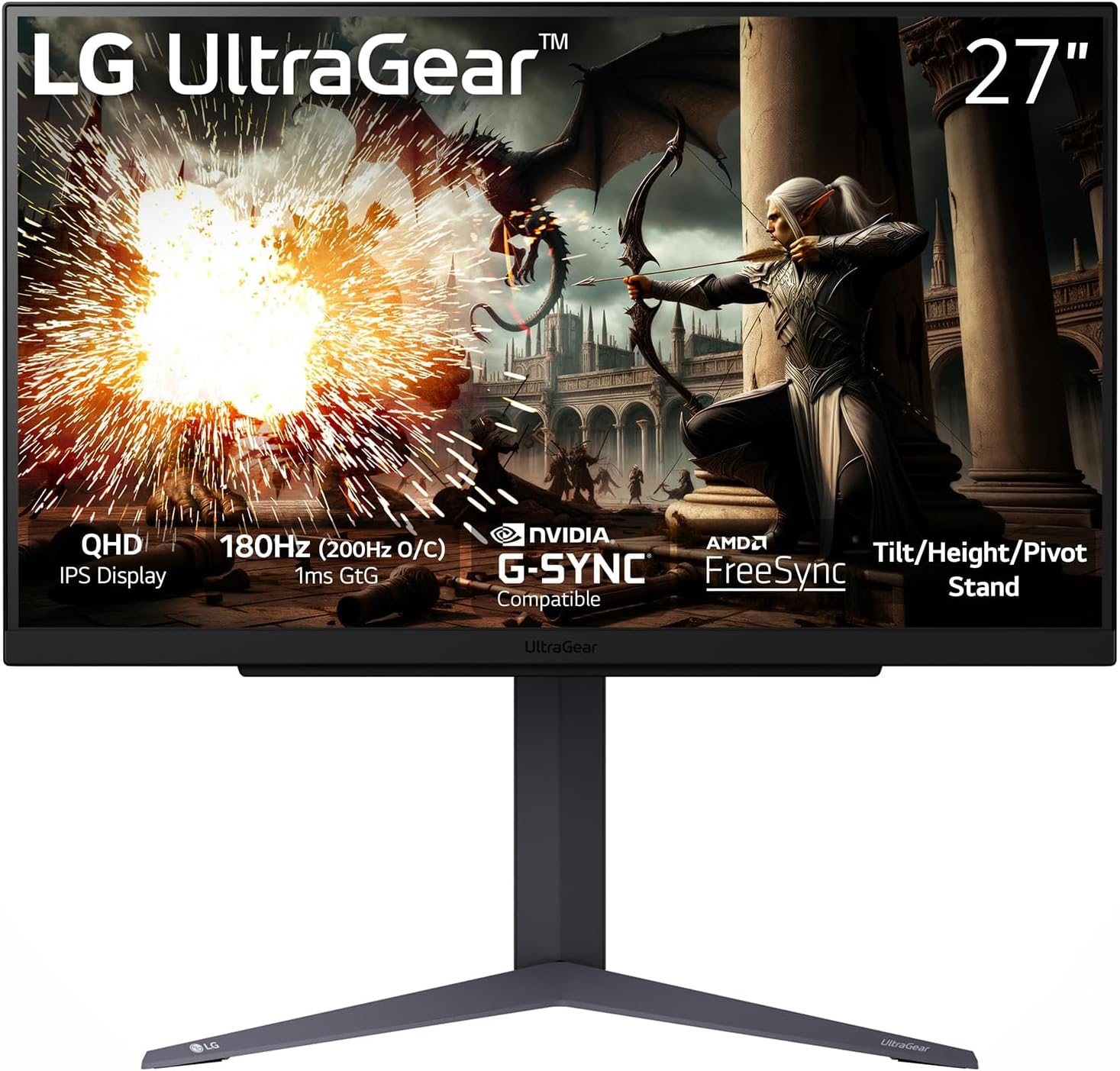
LG UltraGear 27GS — the 1440p Value King
The UltraGear earns box-one placement for the least glamorous reason in the guide: it is the panel most PCs should actually buy. A fast IPS 27-inch at 1440p and 180Hz hits the sweet spot where image sharpness, achievable frame rates and price intersect — around $250–$300 at the time of writing, often less on sale. Motion handling is clean for an LCD, the stand does height and pivot properly, and the HDR checkbox is best ignored (edge-lit brightness, as usual at this price). For esports titles it is effectively endgame; for cinematic games it renders a sharper image per frame-rate dollar than any 4K panel. This is the monitor to pair with a mid-range GPU, and the one that will feel like an upgrade from 1080p/60Hz in the first five minutes. Pricing cited was live at the time of publication — click through to confirm current pricing.
- Pros: outstanding price-to-frame-rate; sharp 1440p at 27 inches; solid stand; forgiving of mid-range GPUs.
- Cons: HDR is nominal; IPS blacks glow in dark rooms; 180Hz is the ceiling, not a speed showcase.
Buy it if your GPU is mid-range or your wallet is the boss. Skip it only if a 4K-class card already sits in your case.
ASUS ROG Swift PG27AQDP — the 4K OLED Flagship
The PG27AQDP is the no-compromise build: a 27-inch 4K OLED running 240Hz with instantaneous response, true-per-pixel blacks, and DisplayPort 2.1 bandwidth that does not need to trade chroma to feed the panel. Games that support HDR come alive in a way LCD HDR never delivers at desk sizes, and competitive titles benefit from OLED motion clarity that makes 240 fps look smoother than LCD numbers suggest. It is the monitor for a flagship GPU — the pairing table's last row — and the one that will not be obsolete when the next GPU tier lands.
Around $1,000+ at the time of writing, it costs multiples of the UltraGear, and OLED ownership carries two practical notes: the burn-in mitigation habits below, and peak brightness that trails the best Mini-LED LCDs in sunlit rooms. In a controlled-light desk setup, nothing else here looks like it.
- Pros: 4K at 240Hz on OLED; perfect contrast; DP 2.1 full bandwidth; the cleanest motion in the test.
- Cons: flagship price; burn-in care habits; HDR brightness trails Mini-LED in bright rooms.
Buy it if a flagship GPU deserves a screen that keeps up. Skip it if the room fights OLED brightness or the budget caps near $400.
Alienware AW2725DF — the QD-OLED Speed Demon
Where the ASUS goes 4K, Alienware's QD-OLED goes sideways: 1440p at a blistering 360Hz on the same quantum-dot OLED family, pairing saturated color with competitive-tier speed. For shooter-first players — the ones tracking jump-pads and peek angles — this is the specialization play: response is identical-instant, motion blur is essentially absent, and 360 fps at 1440p is a realistic daily target on upper-mid GPUs. The design and cable management are thoughtful, and the three-year warranty includes OLED burn-in coverage, which answers the reliability question better than any spec sheet.
That burn-in coverage matters enough to repeat: it is the manufacturer accepting the technology's one structural risk on your behalf, at around $750–$900 at the time of writing. Between the two OLEDs, the fork is simple — cinematic 4K versus competitive 360Hz.
- Pros: 360Hz QD-OLED motion; burn-in coverage in warranty; superb color; sharper value than 4K OLED for esports-first users.
- Cons: 1440p ceiling; QD-OLED subpixel layout slightly softens text; premium price.
Buy it if ranked shooters are your main game and your GPU lives in the upper-mid class. Skip it for cinematic single-player at 4K ambitions.
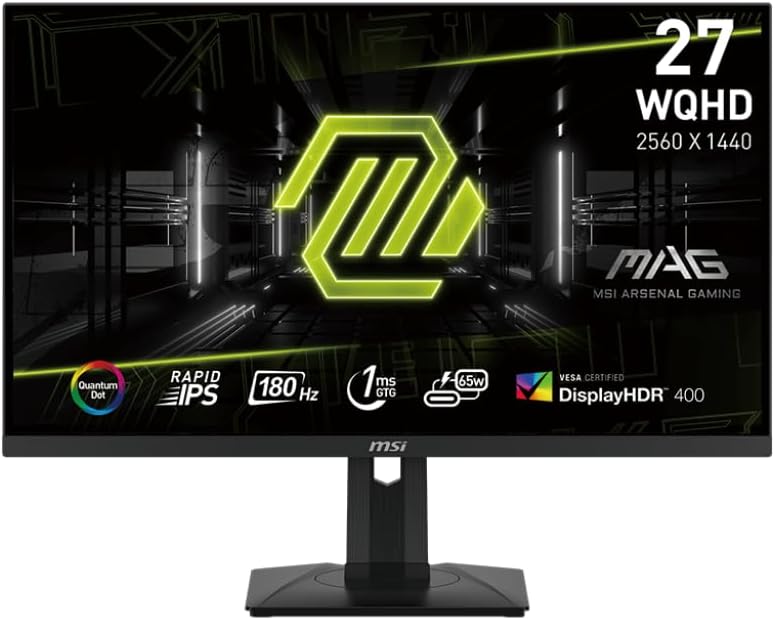
MSI MAG 274QRF QD — the Work-Play Color Hybrid
The MAG 274QRF QD earns its slot by refusing the either/or of gaming versus content work. Its Quantum Dot IPS covers excellent DCI-P3 volume for a LCD at this price, factory calibration is usable straight from the box, and 1440p at 170Hz keeps game nights fast — around $300 at the time of writing. If your desk doubles as a photo, video or design workstation, this is the pragmatic single-monitor answer: color you can trust between meetings, speed you can feel after hours.
The trade is OLED envy in dark rooms — blacks are LCD-good, not OLED-perfect — and HDR is again a checkbox. But for the huge population of work-by-day, game-by-night users, that is a compromise made once, not daily.
- Pros: strong DCI-P3 coverage; credible factory accuracy; 170Hz; stand ergonomics.
- Cons: LCD contrast; no OLED motion; HDR checkbox.
Buy it if one screen must serve deadlines and ranked lobbies. Skip it if the desk is a dedicated battlestation.
Gigabyte M27Q — the Budget Workhorse
The M27Q has outlived several product generations because it keeps landing the fundamentals: a Super Speed IPS 27-inch 1440p panel at 170Hz, decent response for the class, and Gigabyte's excellent OSD with a built-in KVM switch that lets one keyboard and mouse control a second device — a genuinely rare feature at around $220–$250 at the time of writing. As a first gaming monitor, a dorm-room mainstay, or the second screen beside an OLED, it remains one of the easiest recommendations in the category.
What the budget buys away: contrast and brightness headroom, a USB hub worth the name, and the fit-and-finish of the pricier stands. Nothing that touches frames per second.
- Pros: lowest price here; KVM switch; proven panel; full ergonomics for the class.
- Cons: basic HDR and brightness; SS IPS glow in dark scenes; dated styling.
Buy it as a first setup or a secondary screen. Skip it if the budget already reaches the UltraGear's sale prices.
1440p Is Still the Value King — Here Is the Math
The case in numbers: 1440p renders 3.7 million pixels against 4K's 8.3 million — the GPU pays for less than half the pixels, and on a 27-inch desk-distance display the perceptual difference in normal play is modest. Halving the pixel bill buys either double the frame rate on the same card or the same frame rate on a card two tiers cheaper, and frame rate is the specification you feel every second. 4K earns its keep in slow, dense, cinematic titles and desktop sharpness; competitive and fast-action gaming at desk distance still belongs to 1440p. That is why the value pick here is not a consolation — it is the statistically correct answer.
OLED Burn-In: the Honest Answer
OLED's structural risk is that static images stress specific pixels — and games have persistent HUDs. The honest 2026 answer: panel-level mitigations (pixel shift, periodic compensation cycles, logo dimming) plus normal usage rotation have made permanent burn-in rare, and both OLED vendors here either cover burn-in in warranty (Alienware, three years) or run aggressive mitigation (ASUS). The practical habit stack: hide or shrink static HUD elements where the game allows, dim the desktop taskbar, let the monitor idle into its refresh cycle, and do not leave a static game menu on overnight. Do that and the technology's weaknesses mostly stay in the laboratory where the fear came from.
Ultrawide vs 16:9, Briefly
Ultrawides deliver a genuine immersion multiplier in flight, racing and open-world titles, and productivity loves the width — but they cost more per inch, GPUs must render roughly a third more pixels, and competitive titles frequently restrict field of view to keep matches fair. For a mixed gaming diet on one desk, 16:9 remains the rational default; go ultrawide for the love of the format, not the frames.
Top Picks for This Topic
-
1

-
2
-
3

Frequently Asked Questions
- Is 1440p still better than 4K for gaming in 2026? For most 27-inch desk setups, yes — half the GPU cost for a subtle visual difference, and the frame rate you feel every second. 4K wins for cinematic titles, close seating and flagship GPUs.
- Do OLED gaming monitors get burn-in? Permanent burn-in is rare with modern mitigation and normal habits; static HUDs at high brightness for thousands of hours remain the worst case. Alienware covers it in warranty for three years.
- What GPU do I need for 4K 240Hz gaming? A current flagship class for native 240 fps; mid-range cards target 4K 60–120 fps with upscaling. The pairing table above maps GPU class to the right tier.
- Is 180Hz vs 240Hz noticeable? 60-to-180 is dramatic; 180-to-240 is subtle and mainly serves fast-tracking competitive shooters. Below 200 fps, spend on panel quality instead.
- Do I need G-Sync or FreeSync? You want adaptive sync, brand-agnostic — all five monitors here run variable refresh with both GPU camps, eliminating tearing and stutter below the refresh ceiling.
One last pairing note: a great panel deserves audio that keeps up — our noise-cancelling headphones guide covers the other half of a serious battlestation.
As an Amazon Associate, Tutorsbot earns from qualifying purchases. Disclosure.