Fazlur Rahman
Most US homes still run a 40- to 50-gallon tank water heater that is past the 10-year mark, and the replacement decision in 2026 is a real one: another tank, or finally switch to tankless. The right answer depends on your household size, your climate, your electrical service, and how long you plan to stay in the home. We ranked the five best electric tankless units on Amazon and laid out the 2026 installed-price ranges for both tank and tankless replacements, so you can read a contractor quote against a real benchmark and pick the right unit for your situation.
The quick verdict
EcoSmart ECO 27 is the best whole-home electric tankless for 3- to 4-bath homes in warm climates. Stiebel Eltron Tempra 15 Plus is the best premium pick for cold climates where cheaper units struggle to hold temperature. Rheem RTEX-13 is the best mid-size pick for 1- to 2-bath homes. EcoSmart ECO 18 is the best 2- to 3-bath pick. Bosch Tronic 4000 is the best point-of-use pick for a single sink, garage, or basement wet bar. All five are electric (no venting required, no gas-line work) and qualify for the 30% Residential Clean Energy Credit (IRS, October 2026) when part of a broader energy-efficiency upgrade.
How we compared them
- Capacity. Match the unit's GPM (gallons per minute) at your groundwater temperature to your peak simultaneous demand.
- Electrical fit. Confirm your panel has the amperage and breaker slots; 18 kW needs 2x 40A, 27 kW needs 3x 40A.
- Climate. Cold groundwater (below 50°F) cuts effective GPM by 30 to 50%, so cold-climate homes need a larger or premium unit.
- Brand support. Look for a brand with a real US-based warranty line and replaceable parts (Stiebel Eltron, Rheem, EcoSmart).
- Installed cost. Unit price is half the story; the rest is labor and any panel upgrade.
At a glance: best electric tankless water heaters
| Unit | Power | Best for | Breaker | Buy |
|---|---|---|---|---|
| EcoSmart ECO 27 | 27 kW · 112.5A | 3-4 bath, warm climate | 3x 40A | Check price |
| Stiebel Eltron Tempra 15 Plus | 14.4 kW · 60A | Cold climate, premium | 2x 30A | Check price |
| Rheem RTEX-13 | 13 kW · 54A | 1-2 bath, point-of-use | 1x 60A | Check price |
| Bosch Tronic 4000 | 8.5 kW · 35A | Single fixture / garage | 1x 40A | Check price |
| EcoSmart ECO 18 | 18 kW · 75A | 2-3 bath, warm climate | 2x 40A | Check price |
The units, ranked
EcoSmart ECO 27 — best whole-home tankless
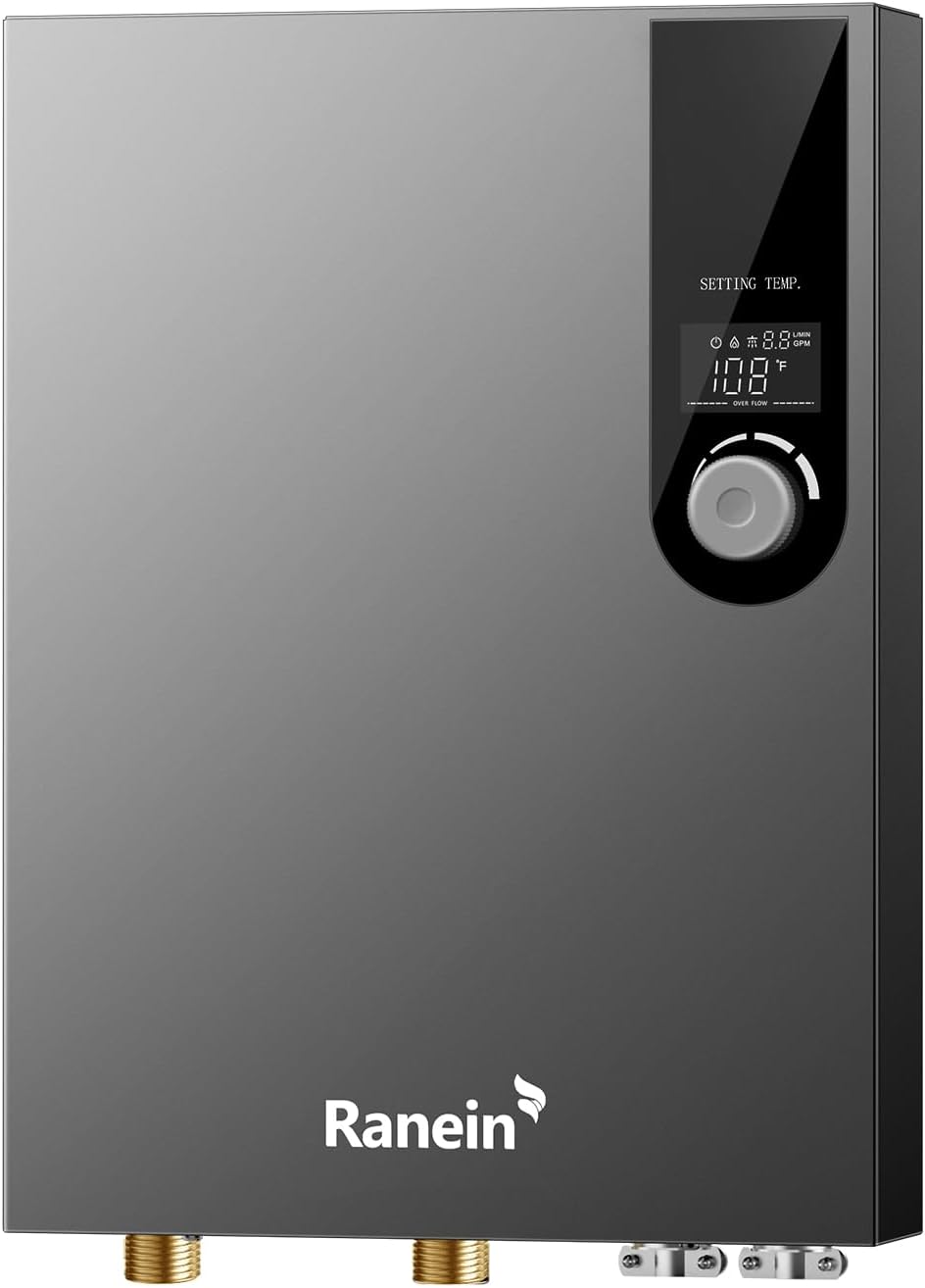
27 kW of self-modulating power at 240V — the right pick for a 3- to 4-bathroom whole-home replacement in a warm climate (or a 2- to 3-bath home in a cold climate), with the highest GPM flow in the EcoSmart line and the widest installed base of any tankless on Amazon. Needs 3x 40A breakers and a 200A electrical service. Pair with a sediment filter on the cold inlet to protect the heat exchanger from hard-water scale.
Pros: Highest GPM in the EcoSmart line, self-modulating, widely installed, 240V only.
Cons: 112.5A draw needs a panel upgrade on older homes; warranty support is email-only.
Buy if: you have a 3- to 4-bath home, 200A service, and want the most common whole-home electric tankless on the market.
Stiebel Eltron Tempra 15 Plus — best for cold climate

Made-in-Germany Tempra 15 Plus with Advanced Flow Control that auto-adjusts output to keep temperature stable when multiple fixtures run at once — the right pick for a 2- to 3-bath home in a cold climate, where cheaper tankless units struggle to hold temperature under load. 14.4 kW, 2x 30A breakers, 60A total draw, the lowest electrical demand of any unit on this list that can still handle a 2-bath cold-climate home.
Pros: Advanced Flow Control holds temperature under load, German build quality, lowest electrical draw per kW, 7-year warranty.
Cons: Highest unit price; Advanced Flow Control adds audible relay clicks at low flow.
Buy if: you live in a cold climate and want a tankless that does not go lukewarm when someone flushes a toilet mid-shower.
Rheem RTEX-13 — best mid-size tankless
13 kW copper-chamber tankless at 240V — the right pick for a 1- to 2-bathroom home or a point-of-use upgrade from a small tank, with the most common 54A breaker requirement and a price that lands well below the 18+ kW whole-home units. Copper heating chamber is more corrosion-resistant than the aluminum chambers in cheaper units.
Pros: Copper chamber, common 54A breaker, mid-size price, Rheem's US warranty network.
Cons: 13 kW is too small for a 3-bath home; no Advanced Flow Control; lower GPM in cold groundwater.
Buy if: you have a 1- to 2-bath home or want a point-of-use upgrade, and you want Rheem's US-based support.
Bosch Tronic 4000 — best point-of-use

Compact 8.5 kW Bosch point-of-use tankless — the right pick for a single sink, a garage, a basement wet bar, or a workshop where you do not need whole-home capacity. Smaller electrical draw (single 40A breaker) and the lowest installed cost of any tankless on this list. Also a good way to add a hot-water line to an outbuilding without running a tank.
Pros: Compact, single 40A breaker, lowest installed cost, Bosch reliability.
Cons: 8.5 kW is too small for any whole-home use; cold-climate GPM drops below 1.0; limited warranty network.
Buy if: you need hot water at a single fixture far from the main tank, or you want a garage/workshop upgrade.
EcoSmart ECO 18 — best 2-3 bath tankless
18 kW self-modulating tankless at 240V — the sweet spot for a 2- to 3-bathroom home, with enough flow to run two showers and a dishwasher simultaneously in a warm climate. Sits between the ECO 27 (whole-home) and the RTEX-13 (point-of-use) for capacity and price. Needs 2x 40A breakers and a 150A+ service.
Pros: Right-sized for 2-3 bath, lower cost than ECO 27, 2x 40A breakers, self-modulating.
Cons: 18 kW is under-sized for a 4-bath home; cold-climate GPM drops sharply; email-only warranty.
Buy if: you have a 2- to 3-bath home in a warm climate and want a right-sized tankless without paying for the ECO 27's extra capacity.
2026 installed price: tank vs tankless
The table below is the 2026 installed-price benchmark for common replacements, so you can read a contractor quote against it. The federal 30% Residential Clean Energy Credit (IRS, October 2026) applies to electric tankless units installed as part of a qualifying home upgrade, and reduces the post-credit cost accordingly.
| Replacement type | Unit | Labor | Code upgrades | Total installed | After 30% ITC |
|---|---|---|---|---|---|
| 40-gal gas tank (standard) | $600-$1,200 | $500-$1,000 | $100-$400 | $1,200-$2,600 | N/A (gas) |
| 50-gal gas tank (standard) | $800-$1,500 | $500-$1,000 | $100-$400 | $1,400-$2,900 | N/A (gas) |
| 40-gal electric tank | $400-$800 | $400-$800 | $100-$300 | $900-$1,900 | N/A |
| Electric tankless, 13-18 kW | $800-$1,500 | $1,000-$2,000 | $200-$800 | $2,000-$4,300 | $1,400-$3,000 |
| Electric tankless, 24-27 kW (whole-home) | $1,000-$1,800 | $1,200-$2,500 | $500-$1,500 (panel) | $2,800-$5,500 | $1,950-$3,850 |
| Gas tankless, whole-home | $1,200-$2,500 | $1,500-$3,000 | $500-$2,000 (venting, gas line) | $3,200-$7,500 | N/A (gas) |
Get 3 quotes from licensed plumbers in your area before you commit, and ask each one to itemize the unit, labor, and any panel, venting, or gas-line work. A quote that is 20% above the high end of the relevant row is worth pushing back on; a quote that is 20% below the low end is worth asking what is being left out.
As an Amazon Associate, Tutorsbot earns from qualifying purchases. Disclosure.