Fazlur Rahman
The exhaust fan bathroom installation cost depends on one thing above all else. It depends on whether a fan is already in place. Swapping an existing fan for a new one is a small job. A bathroom that never had a fan means cutting into a ceiling or a wall. Across the two national cost guides we checked, installed prices ran from $150 to $900. Most homeowners land in the middle of that range.
Below is what moves the number. We split the job by type and price the fan by feature and size. We list the add-ons that show up on the bill. We also show the size and noise rules your fan must meet. A cheap fan that is too small or too loud is not a saving.
How much does exhaust fan bathroom installation cost?
Two cost guides put the national average close together. Fixr, in February 2025, puts the average installed price at $400. Its typical range runs $250 to $900. Inch Calculator puts the average at about $375. Most of its jobs fall between $250 and $550. Fixr's high end reaches $1,000 for a fan with Bluetooth and moisture detection.
| Source | Average | Typical range |
|---|---|---|
| Fixr (Feb 2025) | $400 | $250 to $900 |
| Inch Calculator | $375 | $250 to $550 |
The average matters less than the spread. A replacement and a first-time install do not cost the same. Both sources split their numbers that way.
Why does a new install cost more than a replacement?
A replacement reuses what the house already has. The duct, the wiring, and the opening are all in place. The crew swaps a unit and tests it. Fixr puts the average replacement at $200, with a range of $150 to $500. Labor alone averages about $150.
A first-time install has nothing to reuse. Fixr puts the average at $400. The range runs $250 to $900. Labor averages about $300, then runs from $250 to $500. The extra cost buys duct routing and a power source. It does not buy a bigger fan.
| Job | Average total | Range | Labor average |
|---|---|---|---|
| Replace existing fan | $200 | $150 to $500 | $150 |
| New install, no existing fan | $400 | $250 to $900 | $300 |
| Ceiling new install | - | $400 to $900 | - |
| Wall new install | - | $300 to $500 | - |
| Inline fan | $300 | $200 to $500 | - |
This gap shows up in every exhaust fan bathroom installation cost estimate you get. Say which job you have before anyone quotes.
Mount location shifts the range too. Fixr puts a ceiling replacement near $200. A wall replacement sits near $200 as well. An inline fan runs $200 to $500, with an average near $300.
This kind of fan sits inside the duct instead of at the ceiling or wall. It needs open space above the bathroom to fit.
What does the fan itself cost by feature?
The unit is the smaller half of the bill. Fixr prices materials by feature, and the spread is wide. A basic fan starts near $50. A variable-speed fan reaches $400.
| Feature | Price range |
|---|---|
| Basic | $50 to $75 |
| With light | $50 to $100 |
| With heater | $100 to $300 |
| Low noise | $50 to $150 |
| Humidity sensor | $75 to $125 |
| Motion sensing | $100 to $250 |
| Bluetooth speaker | $150 to $200 |
| Variable speed | $75 to $400 |
Inch Calculator prices the same units a little higher. A basic ceiling or wall fan runs $75 to $125 there. One with both a light and a heater runs $125 to $350. A window fan that plugs in runs $50 to $100. That last one needs no wiring work at all.
What size fan does your bathroom need?
Two numbers decide it. The first is airflow, measured in CFM. CFM stands for cubic feet per minute. The second is sound, measured in sones.
Code sets the floor. The DOE Building America Solution Center names two codes. ASHRAE 62.2 and IRC 2021 Section M1507 set the minimum at 50 cfm. A fan that runs continuously needs at least 20 cfm.
The same DOE guidance suggests 70 cfm or more for intermittent use. For continuous use, go above 50 cfm. The reason is simple. Ducts and terminations cut the airflow you actually get. They push it below the number printed on the box. A fan rated at exactly 50 cfm can move far less than that outside.
Room size helps you narrow it down. Inch Calculator puts a small 5 by 8 foot bathroom at 70 to 90 CFM. A larger bathroom needs about 100 CFM.
Noise has its own ceiling. ASHRAE 62.2 caps intermittent fans at 3 sones. Continuous fans are capped at 1 sone. The DOE Building America Solution Center reports both limits. A sone is the unit used to measure how loud a fan runs.
| Need | Figure | Source |
|---|---|---|
| Code minimum, intermittent | 50 cfm | ASHRAE 62.2 / IRC M1507 |
| Code minimum, continuous | 20 cfm | ASHRAE 62.2 / IRC M1507 |
| ENERGY STAR pick, intermittent | 70 cfm or more | PNNL |
| Small bath about 5 x 8 ft | 70 to 90 CFM | Inch Calculator |
| Fan 70 to 100 CFM price | $50 to $100 | Fixr |
| Fan 100 to 150 CFM price | $75 to $200 | Fixr |
| Max noise, intermittent | 3 sones | ASHRAE 62.2 |
Fan prices rise with airflow. Fixr lists units over 150 CFM at $150 to $300. Budget more once you pass 100 CFM.
What extra costs can show up on the bill?
Inch Calculator prices the add-ons that most often change the bill.
| Item | Cost |
|---|---|
| Electrician tie-in | $100 to $200 |
| HVAC tech for ductwork | $75 to $150 per hour, 1 to 2 hours |
| New outlet | about $200 |
| Building permit | $20 to $100 |
| Speed control switch | $20 to $50 |
| Humidity sensor add-on | $50 to $75 |
Ductwork moves the bill more than the rest. The run to an existing vent may be long or bent. The DOE Building America Solution Center asks for 2 to 3 straight duct feet. It also advises smooth rigid duct. Bends and rough duct cut airflow.
One rule covers the whole job. The same DOE guidance says to vent the exhaust directly outside. Never into an attic, crawlspace, garage, or wall cavity. Use a damper at the termination. A plan that sends air into an attic is not a finished job. Our HVAC system installation cost guide covers the vent and duct side in more detail.
Running the fan long enough is part of the job too. The DOE guidance says to run it about an hour after a shower. A timer switch makes that automatic, and it runs $20 to $50.
Can you replace a bathroom fan yourself?
Swapping a like-for-like unit is reasonable if the wiring stays simple. The housing and the duct stay as they are. Fixr lists most fans up to 150 CFM at $50 to $200. You also skip the $150 average labor Fixr reports for a replacement.
The lines get hard fast. New wiring, a new circuit, or a new duct run is past a casual weekend. An electrician tie-in alone runs $100 to $200. Permits depend on your local building office. Check with them before you pull the old unit off the ceiling.
For a bathroom that never had a fan, hire the work out. It reaches the roof or an exterior wall. A mistake there costs more than the install. If the room is being gutted anyway, price the fan inside the bigger job. Our bathroom remodel cost guide shows what a full gut adds.
How do you get an accurate quote?
Ask for the quote in writing and itemized. You want the fan price, the labor, and each add-on on its own line. A quote that lists ductwork as one line with no hours hides the HVAC time. Ask whether the price covers venting outside, a damper, and the electrical tie-in.
Give the contractor the room size and the location on the first call. Ask whether the space above the bathroom can hold an inline fan.
Bundle other work while the crew is on site. Our water heater replacement cost guide covers a similar swap.
A written quote for exhaust fan bathroom installation cost should show the total installed price. Not the fan price. The total is the number you budget. The fan is usually the smaller half of what you pay.
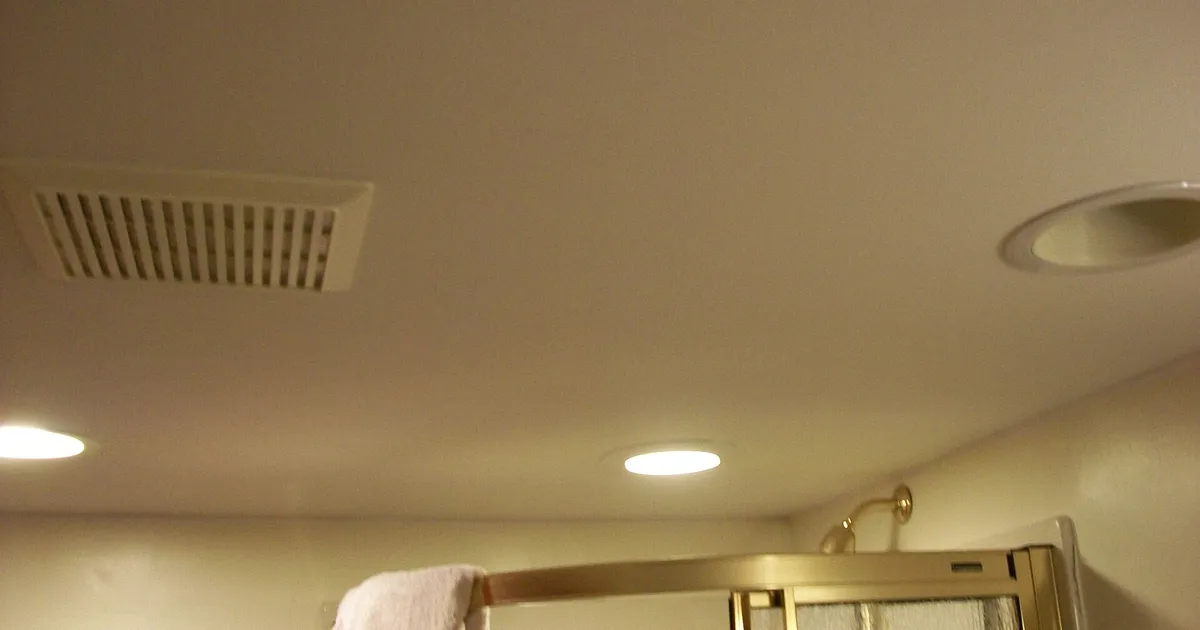
Photo: Tomwsulcer, CC, via Wikimedia Commons (https://upload.wikimedia.org/wikipedia/commons/e/ed/Bathroom_ceiling_with_vent.jpg?utm_source=commons.wikimedia.org&utm_campaign=imageinfo&utm_content=original)