Fazlur Rahman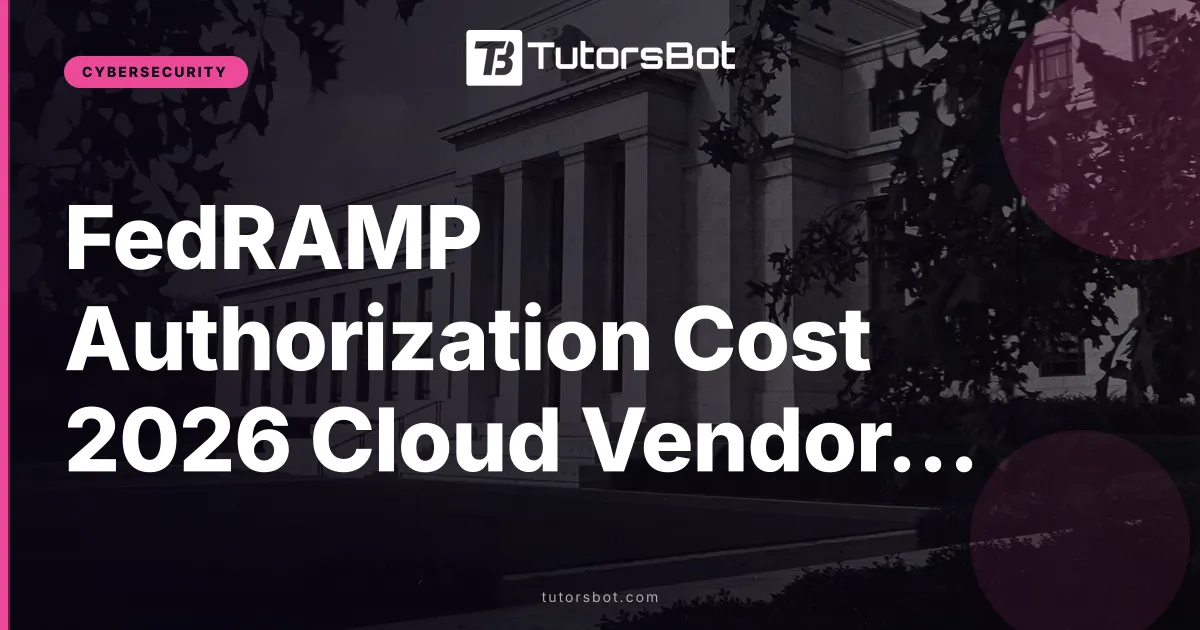
Most cloud service providers spend between $250,000 and $750,000 in the first year to reach a FedRAMP Moderate authorization, and roughly $500,000 to $1,500,000 for FedRAMP High (Source: GSA FedRAMP PMO, 2026). The largest line items are the 3PAO assessment, security engineering remediation, and the documentation package. Annual continuous monitoring adds another $80,000 to $400,000 per year depending on baseline. Vendors that inherit controls from AWS GovCloud, Azure Government, or Google Assured Workloads can cut first-year engineering cost by 30 to 50 percent.
Last verified: Sep 14, 2026.
At a glance
- FedRAMP Moderate first-year cost: $250K-$750K; High: $500K-$1.5M
- 3PAO assessment: $100K-$300K Moderate, $200K-$500K High
- Continuous monitoring: $80K-$250K/yr Moderate, $150K-$400K/yr High
- Inheriting from AWS GovCloud, Azure Gov, or Google Assured Workloads cuts engineering 30-50%
- Typical timeline: 6-18 months Moderate, 12-24 months High
What FedRAMP authorization actually costs
FedRAMP authorization is the federal government's standardized process for approving cloud services. The PMO at GSA runs the program, and only accredited Third Party Assessment Organizations (3PAOs) can issue the security assessment required for an Authority to Operate (ATO). Two baselines exist: Moderate (the most common, covering roughly 325 controls drawn from NIST SP 800-53 Rev 5) and High (around 421 controls). Each baseline scales cost roughly linearly with control count and implementation complexity.

| Cost Component | Moderate Range | High Range | Notes |
|---|---|---|---|
| 3PAO assessment | $100,000 - $300,000 | $200,000 - $500,000+ | Independent security test by an accredited 3PAO |
| Readiness assessment | $30,000 - $80,000 | $50,000 - $120,000 | Pre-authorization gap analysis (optional but recommended) |
| Engineering remediation | $100,000 - $300,000 | $200,000 - $500,000 | Implementing missing controls across infrastructure and code |
| Documentation (SSP, SAP, SAR) | $40,000 - $100,000 | $70,000 - $150,000 | System Security Plan, Security Assessment Plan, Security Assessment Report |
| ConMon year 1 setup | $30,000 - $80,000 | $50,000 - $150,000 | Tooling, dashboarding, monthly scan cadence |
| PMO fees | $5,000 - $15,000 | $5,000 - $15,000 | Listing and authorization processing |
| Year 1 total | $250,000 - $750,000 | $500,000 - $1,500,000 | Excludes internal staff time |
Source: GSA FedRAMP PMO guidance and aggregated 3PAO engagement ranges, 2026.
Continuous monitoring is permanent, not optional
Once authorized, a CSP must run continuous monitoring for the lifetime of the ATO. ConMon covers monthly vulnerability scans, annual security reassessments, POA&M management, significant-change requests, and incident reporting. Skimping on ConMon is the fastest way to lose an ATO.
| ConMon Component | Moderate Annual | High Annual | Frequency |
|---|---|---|---|
| Monthly vulnerability scans | $15,000 - $40,000 | $25,000 - $60,000 | Monthly |
| Annual assessment refresh | $30,000 - $80,000 | $60,000 - $150,000 | Yearly |
| Significant-change reviews | $10,000 - $30,000 | $20,000 - $50,000 | Per change |
| POA&M management | $15,000 - $50,000 | $30,000 - $80,000 | Ongoing |
| 3PAO oversight | $10,000 - $50,000 | $15,000 - $60,000 | Monthly |
| Total ConMon | $80,000 - $250,000 | $150,000 - $400,000 |
Source: GSA FedRAMP PMO continuous monitoring guidance, 2026.
How to reduce FedRAMP authorization cost
The two largest cost levers are cloud provider inheritance and tool-driven automation. Building on AWS GovCloud, Azure Government, or Google Cloud Assured Workloads shifts hundreds of physical and environmental controls to the cloud provider's own authorization, cutting your engineering remediation in half for many architectures. Stack automation platforms such as Vanta, Drata, Secureframe, or Tugboat Logic to streamline evidence collection and control monitoring. Many 3PAOs offer fixed-fee Moderate packages between $120,000 and $180,000 for systems with strong existing documentation, so investing in a clean SSP before engagement saves tens of thousands.

Choosing the right baseline
Pick Moderate unless federal data classification law forces High. Moderate covers most federal workloads that handle non-classified but sensitive information (CUI, PII, financial data). High is required for law-enforcement, emergency services, financial systems, and any data whose loss would have catastrophic impact. Roughly 70 percent of FedRAMP Marketplace authorizations are Moderate (Source: GSA FedRAMP Marketplace, August 2026), and most CSPs can serve the federal market adequately with Moderate scope plus High add-ons for specific data types.
Internal links
Compare FedRAMP costs with related frameworks: SOC 2 compliance cost, ISO 27001 cost, and the CMMC Level 2 cost guide for defense contractors.
Recommended Books for This Topic
-
1

FAQs
See the FAQ section above for FedRAMP authorization cost benchmarks, 3PAO fees, continuous monitoring expenses, and timeline guidance.
FedRAMP authorization phases and timeline milestones
FedRAMP authorization follows a structured milestone path from kickoff to ATO. Most cloud service providers move through Readiness, Authorization, and Continuous Monitoring phases over 12 to 24 months. The Readiness phase (typically 3 to 6 months) establishes the system's security baseline through gap analysis and pre-assessment work. The Authorization phase (typically 6 to 12 months for Moderate, 12 to 18 months for High) covers full SSP documentation, 3PAO assessment, sponsor agency review, and ATO issuance. ConMon is permanent from the day of authorization.
| Phase | Duration | Key Activities | Typical Cost |
|---|---|---|---|
| Readiness Assessment | 1-3 months | Gap analysis, 3PAO pre-assessment, security baseline | $30,000-$80,000 |
| Full SSP & Authorization | 6-12 months Moderate; 12-18 High | SSP, SAP, SAR, sponsor review, ATO issuance | $200,000-$1,000,000 |
| Authorization Decision | 1-3 months | Sponsor agency ATO, JAB P-ATO, or PMO authorization | $20,000-$50,000 |
| Continuous Monitoring Year 1 | Ongoing | Monthly scans, annual assessment, POA&M management | $80,000-$250,000 Moderate; $150,000-$400,000 High |
Source: GSA FedRAMP PMO authorization phase documentation, 2026.
FAQ expansion
Q: Can I self-attest FedRAMP authorization without a 3PAO? No. The FedRAMP PMO requires a 3PAO assessment for all authorizations. The PMO accredits a limited set of 3PAOs through the A2LA process. Self-attestation is not accepted for FedRAMP authorization, unlike SOC 2 Type I which permits self-assessment.
Q: What is the difference between JAB authorization and Agency authorization? The Joint Authorization Board (JAB) is the primary governance body that grants Provisional ATOs (P-ATOs) prioritized across federal agencies. Agency ATO is granted by a single federal agency that wants to use the cloud service. Agency ATOs are more common and faster; JAB P-ATOs carry broader federal acceptance and are typically pursued by vendors seeking maximum government market reach.
Q: How does FedRAMP authorization differ for SaaS vs IaaS vs PaaS? SaaS providers inherit the most controls from underlying IaaS/PaaS providers (AWS GovCloud, Azure Government) and have the smallest direct authorization scope. IaaS providers authorize the underlying infrastructure controls; PaaS providers authorize platform-level controls. SaaS is typically the simplest and fastest path; IaaS is the most complex because the provider owns physical, environmental, and most infrastructure controls.
Photo: U.S. Food and Drug Administration, PUBLIC DOMAIN, via Wikimedia Commons (https://upload.wikimedia.org/wikipedia/commons/c/c5/Federal_Office_Building_No._8_in_1963.jpg?utm_source=commons.wikimedia.org&utm_campaign=imageinfo&utm_content=original)
As an Amazon Associate, Tutorsbot earns from qualifying purchases. Disclosure.