Fazlur Rahman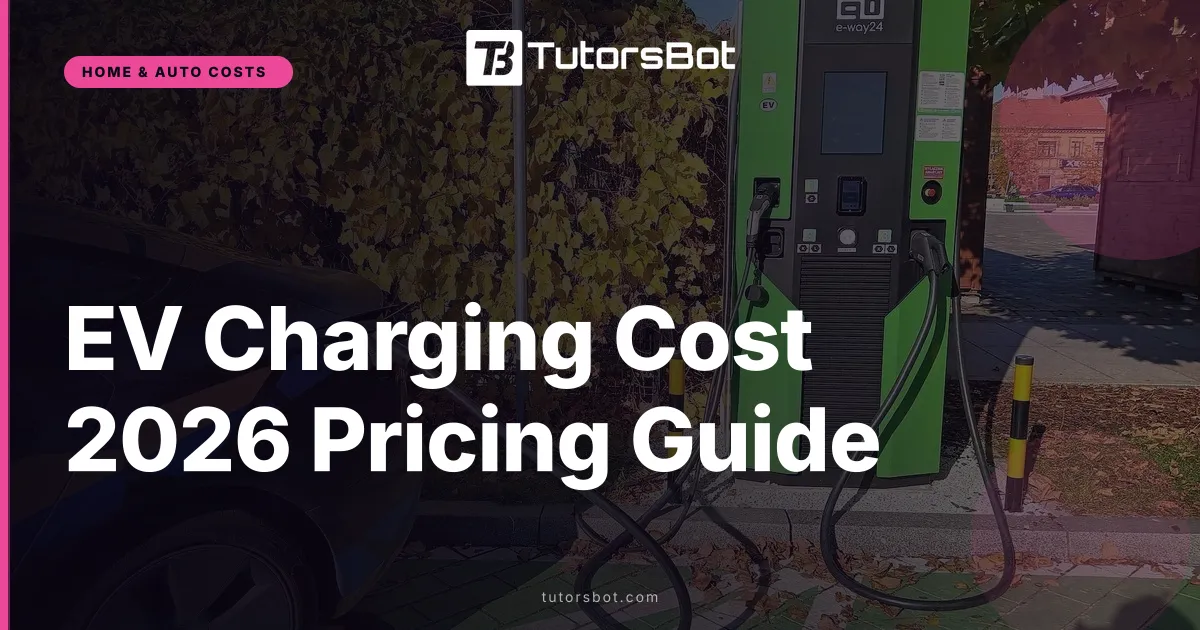
How EV Charging Pricing Works
EV charging pricing is set by the electricity rate and the charger type. Home charging uses the residential electricity rate, which varies by state and by utility, and ranges from 9 cents per kWh in Louisiana to 38 cents per kWh in Hawaii. Public Level 2 charging is typically priced per kWh, per hour, or per session, and ranges from 0.20 to 0.50 dollars per kWh. Public DC fast charging is priced per kWh and ranges from 0.30 to 0.60 dollars per kWh, with idle fees for cars that occupy the charger after the charge is complete. Tesla Superchargers are priced per kWh for non Tesla owners at 0.25 to 0.50 dollars per kWh, with the price varying by region and time of day.
2026 Home Charging Cost
Charging an electric car at home in 2026 costs 4 to 12 cents per mile, depending on the electricity rate and the efficiency of the car. The national average residential electricity rate is 17 cents per kWh, and a typical EV uses 25 to 35 kWh per 100 miles. That works out to 4.25 to 6 dollars per 100 miles, or 600 to 900 dollars per year for the average driver who logs 15,000 miles. Drivers in states with cheap electricity such as Washington, Oregon, and Louisiana can charge for under 4 cents per mile, while drivers in states with expensive electricity such as California, Hawaii, and Connecticut can pay 12 to 15 cents per mile.
2026 Public Charging Cost
Public DC fast charging costs 30 to 60 cents per kWh, which works out to 10 to 20 cents per mile. A 30 minute DC fast charge session can add 150 to 250 miles of range and costs 20 to 35 dollars. Tesla Superchargers cost 25 to 50 cents per kWh for non Tesla owners, with the price varying by region and time of day. Level 2 public chargers, which are the most common at shopping centers and parking garages, cost 1 to 3 dollars per hour or 0.20 to 0.50 dollars per kWh. The cost of public charging is usually 2 to 4 times more expensive than home charging, and DC fast charging is the most expensive option.
How to Install Home Charging
A Level 2 home charger, also called an EVSE, costs 400 to 1,200 dollars for the unit, plus 300 to 1,500 dollars for installation by a licensed electrician. The installation cost varies by the distance from the electrical panel to the charger, the need for a new circuit, and any required panel upgrades. Most homes have enough spare capacity in the electrical panel for a Level 2 charger, but older homes may need a panel upgrade. The Inflation Reduction Act offers a 30 percent federal tax credit, up to 1,000 dollars, for a qualifying home charger installed in 2026. Many states and utilities also offer rebates of 200 to 1,000 dollars for home charger installation.
How to Time Home Charging
Time the home charging for off peak hours, which are usually between 11 PM and 7 AM, since many utilities offer lower rates for off peak usage. A typical time of use rate plan has a peak rate of 25 to 40 cents per kWh during the day, a shoulder rate of 15 to 25 cents per kWh in the morning and evening, and an off peak rate of 8 to 15 cents per kWh at night. Scheduling the EV to charge during off peak hours can cut the charging cost in half. Most EVs have a built in schedule feature in the infotainment system, and most home chargers have a schedule feature in the mobile app.
Public Charging Networks
The largest public charging networks in the United States are Tesla Supercharger, EVgo, Electrify America, ChargePoint, Blink, and FLO. Tesla Supercharger is the most reliable and the most widespread, with over 2,000 stations and 25,000 stalls across the US. Tesla opened the network to non Tesla owners in 2023, and most modern EVs can charge at Superchargers with an adapter or a built in NACS port. EVgo and Electrify America are the largest CCS networks, with stations along major highways. ChargePoint and Blink are the largest Level 2 networks, with stations at shopping centers, parking garages, and workplaces. PlugShare is the most useful app for finding chargers, since it aggregates data from all the major networks.
How to Save on Public Charging
Sign up for membership plans with the major networks, since the per kWh rate is 10 to 30 percent lower for members. Tesla Supercharger membership costs 13 dollars per month for non Tesla owners and unlocks lower per kWh rates. EVgo membership is free and offers reduced rates. Electrify America Pass Plus costs 7 dollars per month and offers reduced rates. ChargePoint membership is free and offers reduced rates at participating stations. For frequent road trippers, a Tesla Supercharger membership is the most valuable, since the network is the largest and the most reliable. Avoid DC fast charging for routine charging, since the higher rates and the battery degradation are not worth the convenience for daily use.
EV vs Gas Cost Comparison
A typical gas car costs 10 to 15 cents per mile at 4 dollar per gallon gas and 30 MPG. A typical EV costs 4 to 6 cents per mile at home, which is roughly half the cost. The savings are 600 to 1,200 dollars per year for the average driver, depending on the gas price and the electricity rate. The savings are even larger for high mileage drivers and for drivers in states with cheap electricity. The break even on the higher purchase price of an EV is 4 to 7 years for most drivers, although the Inflation Reduction Act federal tax credit of up to 7,500 dollars for a qualifying new EV and 4,000 dollars for a qualifying used EV can shorten the break even significantly.
Photo: WrS.tm.pl, PUBLIC DOMAIN, via Wikimedia Commons (https://upload.wikimedia.org/wikipedia/commons/a/af/Tesla_3_charging_at_the_electric_car_charging_station_in_Tomasz%C3%B3w_Mazowiecki%2C_Ko%C5%9Bciuszki_11_Square._October_24%2C_2024.jpg?utm_source=commons.wikimedia.org&utm_campaign=imageinfo&utm_content=original)