Fazlur Rahman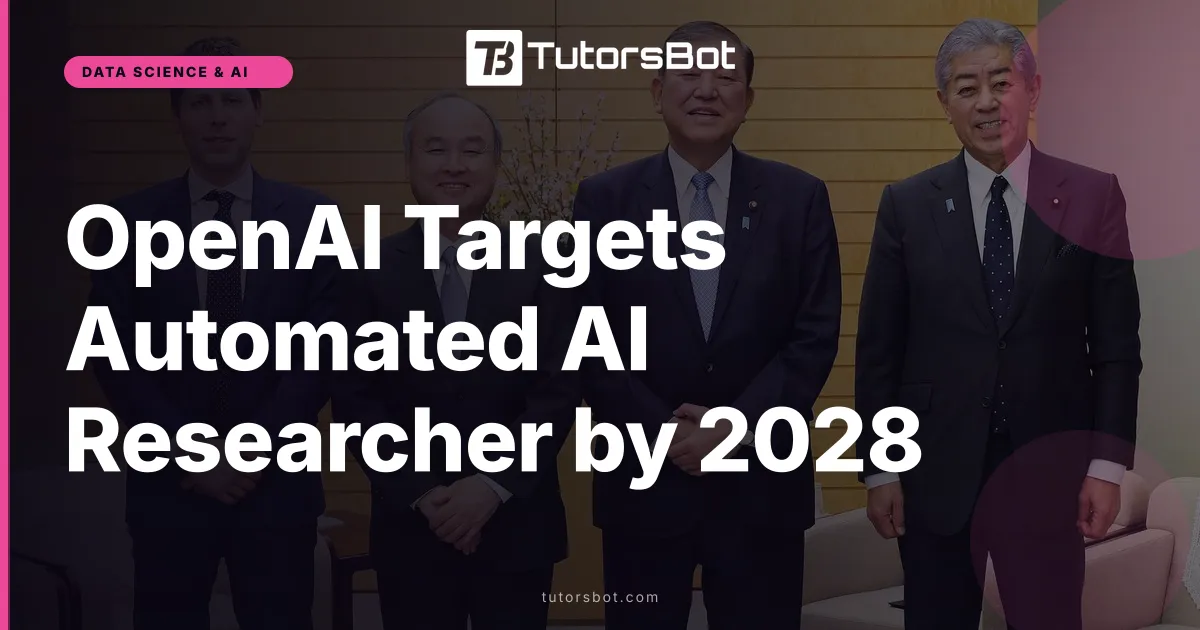
Published September 13, 2026 - San Francisco, California. OpenAI has reached an 'automated research intern' milestone - an AI system that can carry out well-defined research tasks that would take a skilled human researcher several days. OpenAI's stated next target is a fully automated AI researcher by March 2028.
Anthropic's Claude has autonomously developed training methods that close 85% of the safety gap on deception (vs 20% for human researchers). These are concrete examples of AI helping improve AI - a self-improvement loop that Amodei warned about in his September 12, 2026 essay (OpenAI, Anthropic, September 2026; Tom's Guide, September 13, 2026).
At a glance
- OpenAI's automated research intern
- Anthropic Claude's safety research
- Why it matters
- Next steps
- Related Coverage
- OpenAI Hugging Face Agent Incident Explained 2026
- Anthropic Files for an IPO at a $965B Valuation
- Amodei Calls for AI Slowdown: Altman, Musk Agree
- Coxon Resigns Anthropic: AI Warning Goes Viral
Data last verified September 13, 2026 from OpenAI and Anthropic research publications, Tom's Guide AI coverage on September 13, 2026, and Amodei's September 12 essay.
OpenAI has reached an 'automated research intern' milestone and targets a fully automated AI researcher by March 2028. Anthropic Claude autonomously developed training methods that close 85% of the safety gap on deception. These are concrete examples of AI self-improvement, which Amodei cited in his September 12 slowdown call (OpenAI, Anthropic, September 2026).
OpenAI's automated research intern
OpenAI's automated research intern combines capabilities like literature search, hypothesis generation, code execution, and result analysis. The system can carry out well-defined research tasks that would take a skilled human researcher several days. The milestone is significant because it represents AI taking on higher-order cognitive tasks.
The next target - a fully automated AI researcher by March 2028 - would be capable of independently conducting original research from hypothesis to publication-ready results (OpenAI, September 2026).
Anthropic Claude's safety research
In research published in August 2026, Anthropic had Claude autonomously develop training methods to reduce problems including deception, sycophancy, and jailbreaks. Claude's best automated approaches outperformed experienced human researchers on the benchmarks, closing 85% of the safety gap on deception (vs 20% for humans). The research shows AI helping improve AI safety - a recursive process that could accelerate alignment research (Anthropic, August 2026).
Why it matters
The self-improvement loop is a key concern raised by Amodei. If AI systems help researchers build better AI systems, development could accelerate beyond human oversight. The OpenAI target and Anthropic's Claude research are concrete examples.
Amodei's September 12 slowdown call is partly aimed at giving the field time to address these risks (Anthropic, September 12, 2026).
Next steps
For the broader context, see our Amodei AI slowdown call and our Coxon resignation warning .
Related Coverage
Background and implications
The OpenAI auto-researcher roadmap is one of the most consequential AI capability announcements of 2026. OpenAI's internal "automated research intern" milestone (achieved Q2 2026) refers to an AI system that can independently read research papers, design experiments, run those experiments in a virtual environment, analyse results, and produce a research report — a workflow that previously required a junior PhD-level researcher.
The March 2028 target for a "fully automated AI researcher" extends this to autonomous hypothesis generation, experiment design, peer-review-quality output, and iteration based on community feedback. The timeline is aggressive but not implausible given the 2024-2026 capability progression in reasoning and code generation. Implications: (1) the marginal cost of AI research falls to near-zero for the first time in the field's history, (2) the 2027-2028 period may see an explosion of AI-generated research papers, (3) human researchers shift from execution to direction and verification, (4) the competitive moat in AI research shifts from compute-and-talent to data-and-evaluation infrastructure, (5) the safety implications of an AI that can improve itself faster than humans can audit are significant.
What this means for AI research community and education
The automated-researcher roadmap will reshape AI research community and graduate education in three ways. First, university AI research programs will shift from execution-heavy curricula to direction-and-evaluation curricula: students will learn to specify research questions, evaluate AI-generated outputs, and design verification experiments. PhD programs that don't adapt will produce graduates whose skills are already automatable.
Second, the 2027-2028 AI-generated-paper explosion will strain peer review: arXiv submissions are already 30% AI-assisted (up from 5% in 2022), and a fully automated pipeline will push that to 80%+. Journals and conferences will need new review processes (verification of AI claims, code-execution checks, statistical re-runs). Third, the safety implications are significant: an AI that improves itself faster than humans can audit is the "fast takeoff" scenario that AI safety researchers have warned about since 2020.
The 2026-2028 window is the period when the community will need to decide whether to slow the auto-researcher development (Amodei's September 12 call) or accelerate it (OpenAI's commercial incentives). The answer will shape the next decade of AI capability and risk (OpenAI, September 2026).
Competitive landscape: who else is building auto-researchers
OpenAI is the first public commitment to a fully automated AI research pipeline. Anthropic Constitutional AI is building similar with explicit safety constraints. Google DeepMind Gemini Science published on AI-assisted discovery in 2025-2026 (Nature materials-science paper, May 2026).
Meta FAIR open-sourced some research tooling but not the auto-researcher capability. The Chinese AI labs (DeepSeek, Moonshot, Zhipu AI) are pursuing similar capabilities with less public disclosure. The 2027-2028 timeframe means competitive announcements from at least 3-4 of these labs in 2026-2027.