Fazlur Rahman
What puppies need from their food
Puppies need five key nutrients at higher levels than adult dogs because the first year of life is the most rapid growth phase the dog will ever experience. Protein at 25 to 30 percent of the diet supports muscle and tissue growth, since puppies build muscle mass much faster than adult dogs. Fat at 10 to 15 percent provides concentrated energy for the rapid growth phase, since puppies need 2 to 3 times the calories per pound of body weight compared to adults. DHA from fish oil at 0.1 percent or higher of the diet supports brain and eye development, since the puppy's nervous system develops rapidly in the first 6 months. Calcium at 0.8 to 1.2 percent of the diet supports bone growth, with large breed puppies needing the lower end of the range to prevent rapid bone growth that leads to joint problems. Probiotics and prebiotics support digestive health, since the puppy's gut microbiome is still developing.
The right puppy food has all five nutrients at the right levels, plus an AAFCO statement confirming the food meets the nutritional profile for growth and development. The AAFCO statement is on every bag of commercial puppy food and reads Complete and Balanced for Growth or All Life Stages. The Growth statement means the food is formulated for puppies, with the right nutrient levels. The All Life Stages statement means the food is formulated for both puppies and adults, which works for puppies if the nutrient levels meet the Growth profile. The right call is to check the AAFCO statement before buying and to choose a food that says Complete and Balanced for Growth.
The 5 best puppy foods in 2026
Hill's Science Diet Puppy

Hill's Science Diet Puppy is the number one veterinarian-recommended puppy food in the US. The formula uses chicken meal and whole wheat as the primary ingredients, with controlled calcium at 0.95 percent of the diet, DHA at 0.12 percent, and the Hill's proprietary antioxidant blend for immune support. The price runs 55 to 70 dollars for a 15-pound bag, or about 25 to 35 cents per day for a 10-pound puppy. Hill's is the right pick for most puppies, especially large and giant breed puppies who need the controlled calcium for healthy skeletal growth. The trade-off is the use of chicken and wheat, which a small number of puppies with allergies may not tolerate.
Purina Pro Plan Puppy
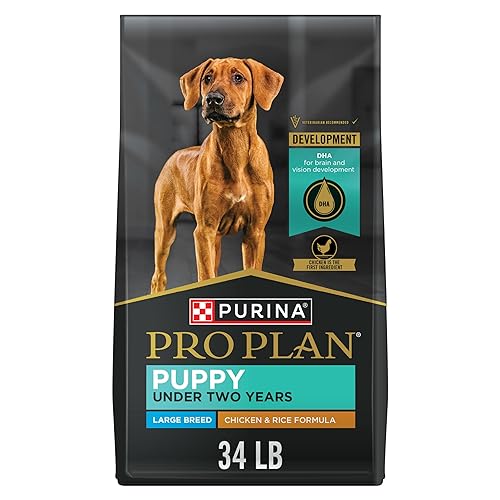
Purina Pro Plan Puppy uses real chicken as the first ingredient, plus rice and barley, with 28 percent protein and live probiotics for digestive health. The price runs 60 to 75 dollars for an 18-pound bag, or about 30 to 40 cents per day for a 10-pound puppy. Purina Pro Plan is the right pick for puppies with sensitive stomachs, since the live probiotics reduce digestive issues. The trade-off is the higher price per pound compared to Hill's, though the added probiotics are worth it for puppies with sensitive digestion.
Royal Canin Puppy

Royal Canin Puppy uses breed-size specific kibble shapes that are matched to the jaw size of small, medium, or large breed puppies. The formula includes chicken by-product meal, brewers rice, and corn, with the proprietary antioxidant complex and omega-3 EPA and DHA. The price runs 65 to 80 dollars for a 30-pound bag, or about 20 to 30 cents per day for a 10-pound puppy. Royal Canin is the right pick for breed-specific needs, since the kibble shape and nutrient levels are matched to the size and metabolism of the specific breed. The trade-off is the use of chicken by-product meal, which some owners prefer to avoid.
Blue Buffalo Life Protection Puppy

Blue Buffalo Life Protection Puppy uses deboned chicken as the first ingredient, with brown rice and barley, plus the LifeSource Bits cold-formed blend of antioxidants, vitamins, and minerals. The price runs 55 to 70 dollars for a 15-pound bag, or about 25 to 35 cents per day for a 10-pound puppy. Blue Buffalo is the right pick for owners who prefer natural ingredients and are willing to pay a 10 to 15 percent premium for the natural positioning. The trade-off is that Blue Buffalo's natural positioning does not always translate to better nutrition, and some puppies with sensitive stomachs do better on Hill's or Purina.
Iams ProActive Health Puppy

Iams ProActive Health Puppy uses chicken and whole grains, with prebiotics, omega-3 DHA, and 27 percent protein. The price runs 50 to 65 dollars for a 15-pound bag, or about 22 to 30 cents per day for a 10-pound puppy. Iams is the right pick for budget-conscious owners who want a quality puppy food at the lowest price per pound. The trade-off is that Iams uses a more traditional ingredient profile than some competitors, without the exotic proteins or natural positioning of Blue Buffalo or the breed-specific kibble shapes of Royal Canin.
How to choose the right puppy food by breed size
The right puppy food depends on the breed size. For small breed puppies (under 20 pounds at maturity, like Chihuahuas, Yorkshire Terriers, and Pomeranians), the right pick is a small-breed-specific formula with smaller kibble size and higher calorie density. Small breed puppies have faster metabolisms and need more calories per pound of body weight, so a small-breed formula prevents the puppy from needing to eat a large volume of food to meet energy needs. The top small breed pick in 2026 is Royal Canin Small Puppy.
For medium breed puppies (20 to 50 pounds at maturity, like Beagles, Border Collies, and Bulldogs), the right pick is a standard puppy formula with moderate kibble size and standard nutrient levels. The top medium breed pick in 2026 is Hill's Science Diet Puppy or Purina Pro Plan Puppy. For large breed puppies (50 to 90 pounds at maturity, like Labradors, Golden Retrievers, and German Shepherds), the right pick is a large-breed-specific formula with controlled calcium at the lower end of the safe range. Large breed puppies grow too fast on standard puppy food, and the controlled calcium prevents the skeletal growth issues that lead to hip and elbow dysplasia. The top large breed pick in 2026 is Hill's Science Diet Large Breed Puppy or Purina Pro Plan Large Breed Puppy.
How to introduce a new puppy food
The right way to switch a puppy to a new food is gradually over 7 to 10 days, mixing the new food with the old food in increasing proportions. Day 1 to 3 is 25 percent new food and 75 percent old food. Day 4 to 6 is 50/50. Day 7 to 9 is 75 percent new food and 25 percent old food. Day 10 is 100 percent new food. The gradual switch gives the puppy's gut microbiome time to adjust to the new protein and carbohydrate sources, and reduces the risk of digestive upset, which is the most common reason puppies reject a new food.
If the puppy shows signs of digestive upset during the switch, such as loose stool, vomiting, or reduced appetite, the right approach is to go back to the previous ratio for 2 to 3 more days, then try to advance again more slowly. Most puppies adjust to a new food within 2 weeks, and the right amount of food is the amount that maintains a healthy body condition with visible waist and palpable ribs. Overfeeding is the most common puppy feeding mistake, since the feeding chart on the bag often recommends more food than most puppies need.
Bottom line
The best puppy food in 2026 is Hill's Science Diet Puppy for most puppies. Purina Pro Plan Puppy is best for sensitive stomachs. Royal Canin Puppy is best for breed-specific kibble shape. Blue Buffalo is best for natural ingredients. Iams is best for the lowest price per pound. The right approach is to check the AAFCO statement for Complete and Balanced for Growth, choose a food matched to the breed size, commit to 6 to 12 months of use, and switch to adult food at the right time for the breed. A sudden food switch is the most common cause of puppy digestive issues, so the right call is a gradual transition over 7 to 10 days.
As an Amazon Associate, Tutorsbot earns from qualifying purchases. Disclosure.